
Ever wonder why the throw pillows on your sofa never look quite right? You’ve bought beautiful pillows, arranged them carefully, and yet somehow they still look… off. Meanwhile, every designer photo you see has pillows that look effortlessly perfect, like they just naturally fell into place.
Here’s the secret: there’s actually a formula. Professional designers don’t just toss pillows on furniture and hope for the best. They follow specific guidelines about size, placement, texture, and pattern that create visual harmony every single time.
Once you understand this formula, you’ll be able to style throw pillows like a pro in any room. No more second-guessing, no more “this doesn’t look right but I don’t know why,” and definitely no more pillow chaos. Just beautifully styled, designer-level perfection that makes your furniture look like it belongs in a magazine.
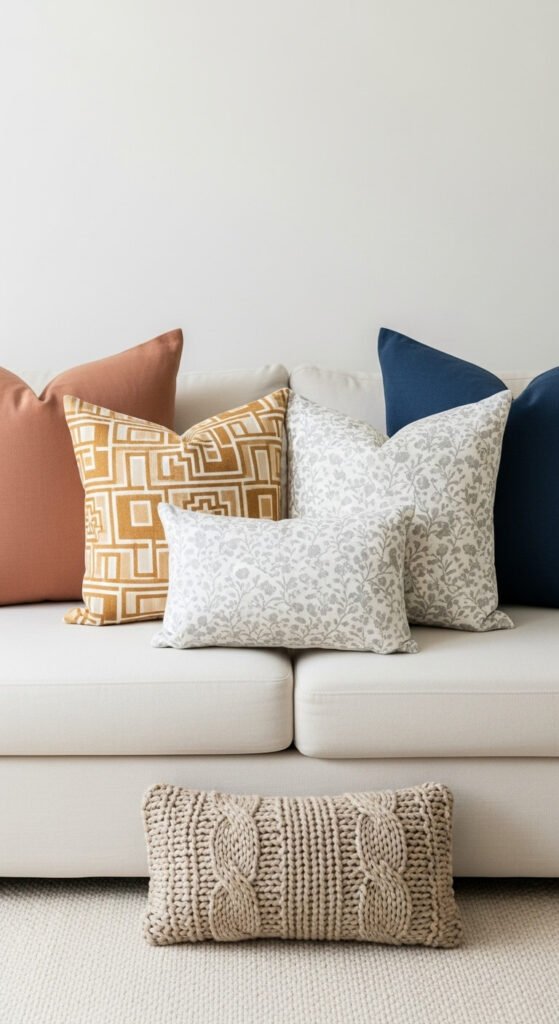
Follow The Size-Down Rule (Largest To Smallest)
This is the foundation of pillow styling. Always start with your largest pillows and work down to your smallest, creating a layered effect that looks intentional.
The standard sizing formula:
For a standard sofa (6-8 feet long):
- 2 large pillows (22-24 inches) on the outer edges
- 2 medium pillows (20 inches) in front of those
- 1 small accent pillow (12×20 lumbar or 18 inches) in the center
For a sectional:
- Scale up: 24-26 inch pillows on the ends
- Layer 3-4 medium pillows (20-22 inches)
- Add 1-2 small accent pillows
For a loveseat or chair:
- 2 medium pillows (18-20 inches) OR
- 1 large (22 inches) + 1 small accent (12×16 lumbar)
The size progression creates depth and visual interest. Same-sized pillows lined up look flat and boring—the size variation is what creates that layered, professional look.
Use The Odd Number Rule (3, 5, Or 7 Pillows)
Designers swear by this, and once you understand it, you’ll see it everywhere. Odd numbers create visual balance that feels more natural and dynamic than even numbers.
How to apply it:
- Standard sofa: 5 pillows is the sweet spot (2+2+1)
- Large sectional: 7 pillows (3+3+1 or 4+3)
- Loveseat or armchair: 3 pillows maximum
- Bed: 5-7 pillows (depending on bed size)
Why odd numbers work: Even numbers create symmetrical pairs that feel formal and static. Odd numbers prevent perfect symmetry, which actually makes arrangements feel more balanced and organic. Your eye moves through the arrangement instead of splitting it into matching halves.
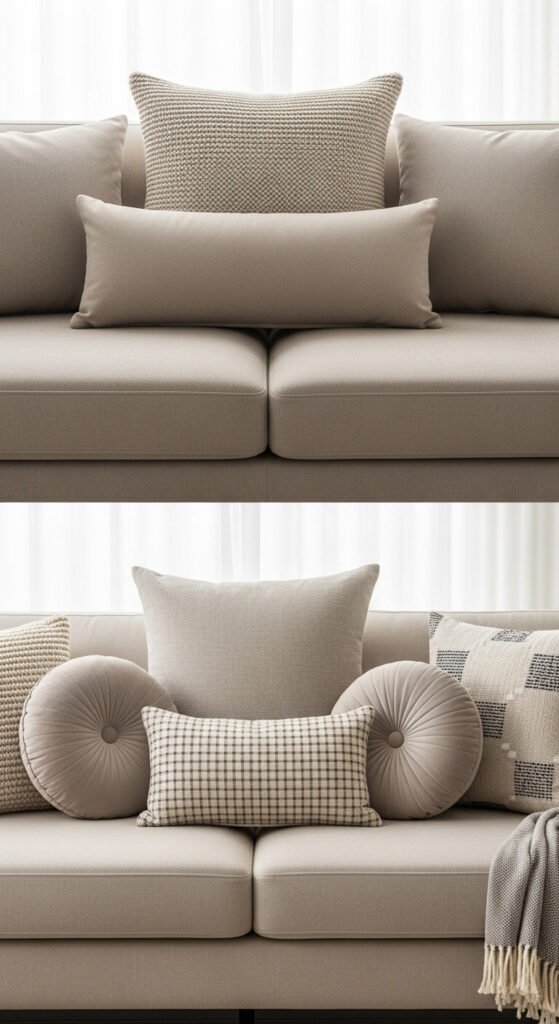
Master The Pattern And Texture Mix
This is where most people struggle. The secret is mixing three types of patterns/textures in specific proportions.
The designer’s mixing formula:
Pattern 1 (Large Scale): Bold pattern with large-scale design—geometric, floral, or abstract (use on 1-2 pillows)
Pattern 2 (Small Scale): Subtle pattern with smaller details—stripes, dots, small prints (use on 1-2 pillows)
Pattern 3 (Solid or Texture): Solid color or textured fabric—velvet, linen, cable knit, faux fur (use on 2-3 pillows)
The proportions matter:
- 40% large pattern
- 30% small pattern
- 30% solid/texture
This creates visual interest without chaos. All patterns should share at least one color to tie everything together.
Choose A Cohesive Color Palette
Random colors scattered across your pillows create visual noise. A cohesive color story is essential for that pulled-together designer look.
Color strategy:
Pick your palette (3-4 colors maximum):
- 1 dominant neutral (white, cream, gray, beige)
- 1-2 accent colors (pulled from your room’s existing colors)
- 1 metallic or texture element (optional but adds richness)
Color distribution:
- Largest pillows: Usually solid in your dominant neutral
- Medium pillows: Introduce patterns with your color palette
- Small accent pillow: Pop of your boldest accent color or pattern
All pillows should feel like they belong to the same color family. If you squint at your arrangement, the colors should flow and blend rather than jump out as disconnected spots.
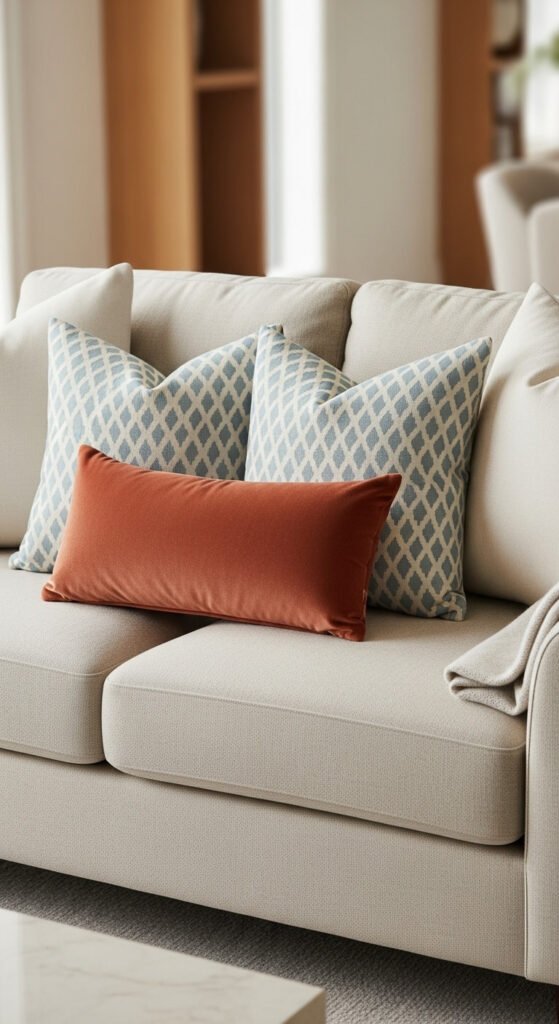
Layer Different Textures For Richness
Texture is what separates amateur pillow styling from professional. Mixing materials creates depth and visual interest that same-fabric pillows can’t achieve.
Texture combinations that work:
Smooth + Rough:
- Velvet paired with chunky knit
- Silk paired with linen
- Leather paired with boucle
Soft + Structured:
- Down-filled pillows with structured foam pillows
- Faux fur with crisp cotton
- Cable knit with smooth cotton canvas
Shiny + Matte:
- Satin paired with textured weave
- Metallic accent fabric with flat linen
Aim for at least 3 different textures in your pillow arrangement. This tactile variety makes people want to touch and interact with your space—the ultimate sign of inviting, well-styled furniture.
Position Pillows With Purpose
How you place pillows matters just as much as which pillows you choose. Strategic positioning creates balance and functionality.
Placement rules:
Outer pillows (largest):
- Placed directly against the sofa arms
- Stand upright, providing structure
- These are your anchors
Middle pillows:
- Slightly overlapping the outer pillows
- Angled slightly inward (not rigidly upright)
- Create that layered, relaxed look
Center accent pillow:
- Either centered perfectly OR
- Slightly off-center for asymmetrical interest
- Often placed horizontally if it’s a lumbar
The fluff factor: Fluff and reshape pillows regularly! Flat, deflated pillows ruin even the best arrangement. Karate chop the center of square pillows to create that designer “puff” on either side.

Consider Pillow Inserts And Quality
The pillows themselves matter. Quality inserts make cheap pillow covers look expensive, while bad inserts make expensive covers look cheap.
Insert wisdom:
Size up your inserts:
- For an 18-inch cover, use a 20-inch insert
- For a 20-inch cover, use a 22-inch insert
- This creates that full, plump look
Choose down or down-alternative:
- Avoid flat, thin polyester inserts
- Down-alternative is budget-friendly and animal-friendly
- Higher fill weight = fuller pillows
The squeeze test: Your pillow should be firm enough to hold its shape but soft enough to be inviting. If it’s rock-hard or deflates immediately when touched, the insert quality is wrong.
Investing in quality inserts transforms cheap covers into designer-looking pillows. This is where to spend your money for maximum impact.
Use Lumbar Pillows As Your Secret Weapon
Lumbar pillows (rectangular, typically 12×20 or 14×24 inches) are the finishing touch that professional stylists always include.
Why lumbar pillows work:
- Break up the monotony of square pillows
- Add visual interest through shape variation
- Provide functional lower back support
- Create a focal point in the center of the arrangement
- Perfect for introducing bold patterns or colors
Place lumbar pillows:
- Horizontally in the center of your sofa
- On the corner of a sectional
- On accent chairs (perfect scale for smaller furniture)
- At the foot or front of bed pillows
Lumbar pillows are the “jewelry” of your pillow arrangement—that final detail that elevates everything.

Seasonal Pillow Swapping Made Easy
One of the beauties of mastering pillow styling is how easily you can refresh your space seasonally without buying all new pillows.
Smart swapping strategy:
Keep year-round:
- Your largest neutral pillows (these are pricey, so invest once)
- Quality inserts (these never need changing)
Swap seasonally:
- Accent pillows and covers (small investment, big impact)
- Texture focus (cable knits for winter, linen for summer)
- Color palette shifts (warm tones for fall, bright for spring)
Budget hack: Buy pillow covers instead of complete pillows. Swap covers on your existing inserts for instant seasonal updates at a fraction of the cost. A $15 cover swap transforms your entire sofa’s look.
This approach lets you follow trends and change with the seasons without breaking the bank or cluttering your storage.
Avoid These Common Styling Mistakes
Even with the formula, certain mistakes can sabotage your efforts. Know what to avoid for foolproof styling every time.
Don’t do this:
❌ All same-sized pillows: Creates a flat, lineup look ❌ Too many patterns: More than 2-3 patterns reads as chaotic ❌ Undersized inserts: Creates flat, sad-looking pillows ❌ Perfect symmetry: Feels formal and stiff rather than inviting ❌ Clashing color schemes: Random colors that don’t relate ❌ Overcrowding: More than 5 pillows on a standard sofa is too much ❌ Ignoring scale: Tiny pillows on huge sectionals look lost
When in doubt, remove one element. Less is almost always more when it comes to pillow styling.
Ready to style your throw pillows like a professional designer? Start with the size-down rule, use odd numbers, and remember to mix your patterns and textures intentionally. The formula works every single time once you understand it. Save this guide for your next pillow refresh—your sofa is about to look like it belongs in a design magazine! 🛋️✨