
The sideboard is one of the hardest-working pieces of furniture in your home — and one of the most consistently understyled. It holds the things no other surface wants: extra dishes, tablecloths, batteries, serving platters, the charger for the device you only use occasionally. And then, because it’s doing all that invisible work, it often ends up looking like a staging area rather than a considered, beautiful focal point. Here’s the good news: it can absolutely be both. A sideboard that’s styled well doesn’t just look beautiful — it stays functional, stays organized, and makes the whole room feel more put-together. Here’s exactly how to get there.
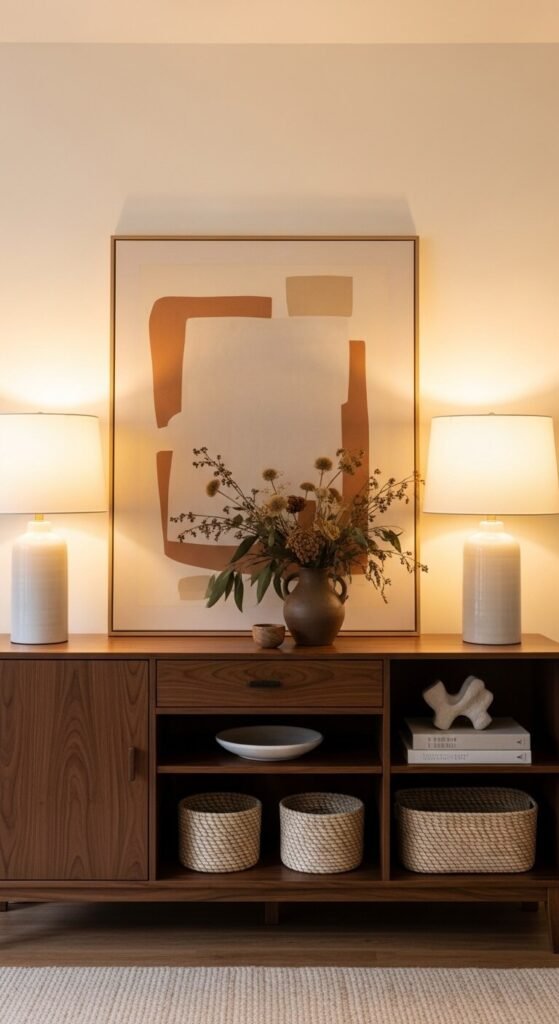
Get the Interior Organized First
Beautiful sideboard styling starts on the inside. Before a single decorative object goes on top, the storage within needs to be working properly — because a sideboard that’s chaotic inside will always find a way to look chaotic outside too. Clutter migrates.
Start by emptying it completely and asking honestly: what actually needs to live here?
Good candidates for sideboard storage:
- Dining essentials — extra napkins, placemats, tablecloths, and serving pieces you use regularly
- Entertaining extras — candles, matches, a wine opener, cocktail napkins
- Practical but unsightly items — batteries, extension cords, takeout menus, instruction manuals
- Seasonal items — items that rotate in and out a few times a year rather than sitting on permanent display
Once you’ve decided what stays, contain it properly. Drawer dividers for small items, fabric-lined baskets or bins inside cabinet sections, and clearly defined zones for different categories. An organized interior makes the entire piece feel more intentional — even when the doors are closed.
Work With a Styling Framework, Not Just Instinct
The top of a sideboard is a long, horizontal surface — and horizontal surfaces are notoriously easy to either leave too sparse or pile too high. A simple framework takes the guesswork out of it entirely.
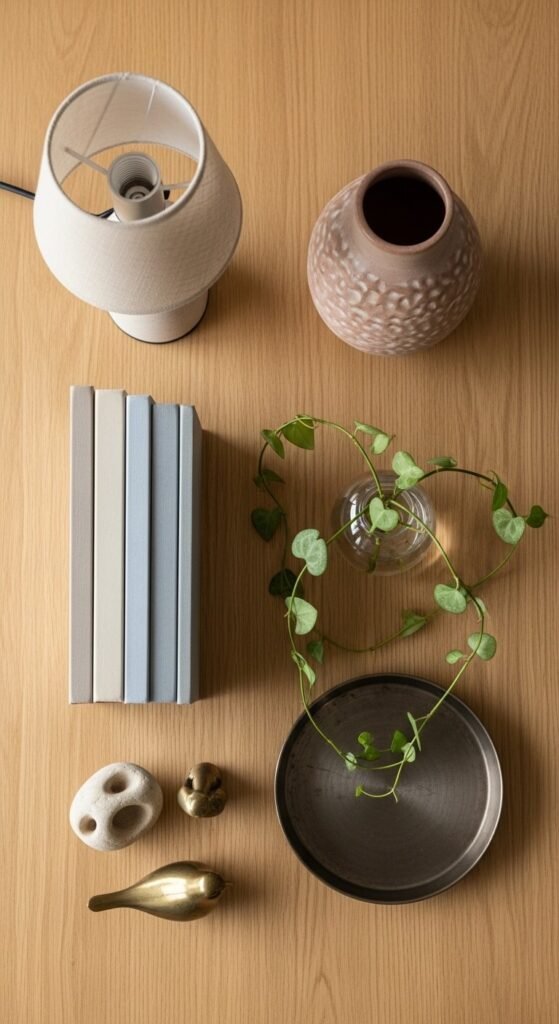
The framework that works on almost every sideboard:
- Anchor each end — two matching or complementary objects at either side create a sense of balanced structure. Lamps are the most powerful choice here: they add height, warmth, and function all at once. Matching plants, tall vases, or lanterns work equally well.
- Create a central focal point — this is the hero of your display. A large piece of art leaning against the wall, an oversized mirror, a statement vase with dramatic stems, or a sculptural object that commands attention.
- Fill the middle ground — between your anchors and your focal point, layer in objects at varying heights: a stack of books, a small tray, a candle, a low bowl. This is where the personality lives.
- Leave deliberate breathing room — not every inch of the surface needs to be covered. Empty space is not a problem to solve. It’s what keeps the display from looking cluttered.
Think of it as a composition — left, center, right — with height variation creating visual movement across the whole surface.
Choose Objects That Earn Their Place
A well-styled sideboard holds only objects that are genuinely beautiful, genuinely useful, or ideally both. Every single item on the surface should be able to answer the question: why does this live here?
Objects that consistently earn their place:
- A pair of table lamps — practical, warm, and structurally essential. They do more visual heavy lifting than almost anything else.
- A piece of leaning art or a mirror — adds vertical scale that the sideboard itself can’t provide and anchors the whole composition to the wall behind it
- A vase with fresh or dried stems — brings life, color, and organic texture that softens the hard lines of the furniture
- A tray — corrals smaller items, creates a defined zone, and makes the display look intentional rather than scattered
- A stack of beautiful books — adds height variation, personality, and a warm sense of the people who live in the home
- One sculptural or meaningful object — a ceramic bowl, a found stone, a small piece of pottery, a travel souvenir. The thing that makes it yours.
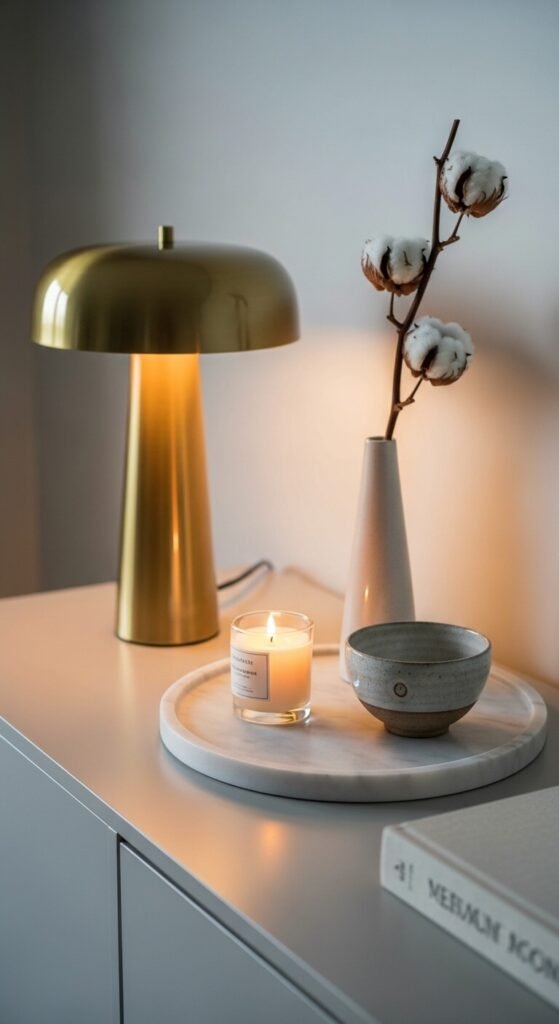
What doesn’t earn its place: things that ended up there because they had nowhere else to go. Keys, mail, children’s artwork that hasn’t been framed, half-used candles, objects from other rooms that migrated in. These get a home elsewhere or get edited out entirely.
Use Height to Create Visual Movement
A sideboard styled entirely with objects of the same height is the decorating equivalent of a flat horizon — technically fine, but visually unengaging. Height variation is what creates the rhythm and movement that makes a display worth looking at.
Aim for at least three distinct height levels across your sideboard:
- Tall — a lamp, a large vase, a leaning mirror or artwork that extends above the surface
- Medium — a smaller vase, a stack of books, a lantern, a plant at mid-height
- Low — a tray, a bowl, a flat object, a small sculptural piece that sits close to the surface
The eye should travel across the display in a gentle wave — up, down, up — rather than scanning a flat line. That wave is what holds attention and creates the feeling that the space has been thoughtfully composed.
Refresh It Seasonally to Keep It Feeling Alive
A sideboard that never changes starts to disappear — you stop seeing it, stop appreciating it, and eventually stop maintaining it. A simple seasonal refresh takes fifteen minutes and completely renews the whole piece.
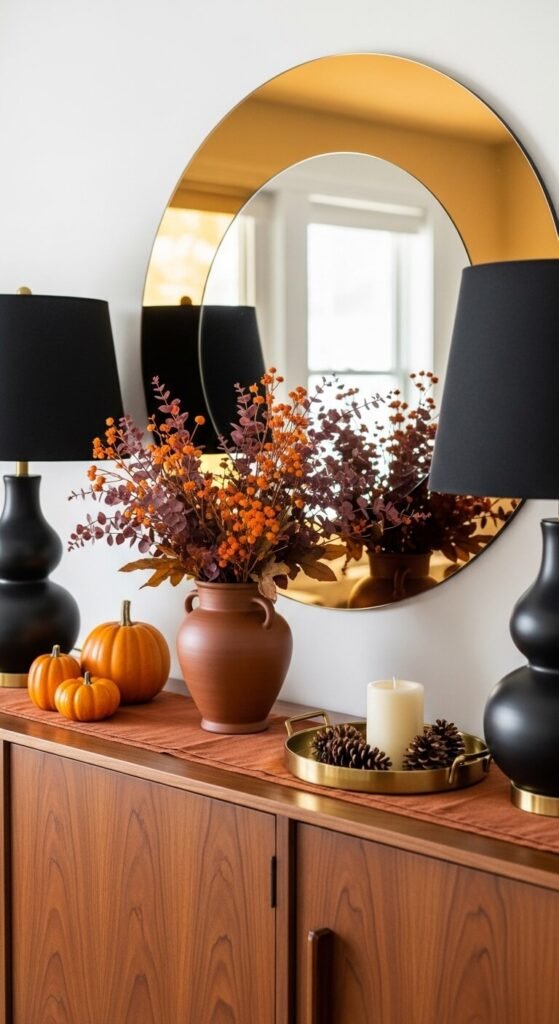
Seasonal swap ideas that take almost no effort:
- Spring — fresh flowers or blossoming branches, lighter colored linens, soft botanical prints
- Summer — a bowl of lemons or limes, pale linen, trailing greenery, driftwood or shells
- Autumn — dried botanicals in warm tones, a table runner in rust or camel, pinecones and candles
- Winter — evergreen sprigs, brass and gold accents, hurricane candle holders, a rich velvet or wool runner
You don’t need new furniture to make your home feel seasonally alive. You just need a sideboard styled with a little intention — and the willingness to change it four times a year.
The Takeaway
A beautifully styled sideboard is the result of two things working together: a well-organized interior that handles the practical chaos, and a composed surface that handles the visual beauty. Get both right, and you have a piece of furniture that genuinely elevates the whole room.
Save this article for your next weekend styling session — clear the surface, follow the framework, and let your sideboard finally become the focal point it was always meant to be. 🕯️✨