
There was a time when every interior design rule insisted that your metals had to match — brass with brass, chrome with chrome, nothing mixed, nothing straying from the set. That rule is officially retired. The most beautiful, layered, and sophisticated homes today mix metals freely and confidently — and the results look infinitely more interesting than a perfectly coordinated set ever could. The key isn’t to throw everything together and hope for the best. It’s knowing how to mix, which metals play well together, and where to let each one shine. Here’s everything you need to know.
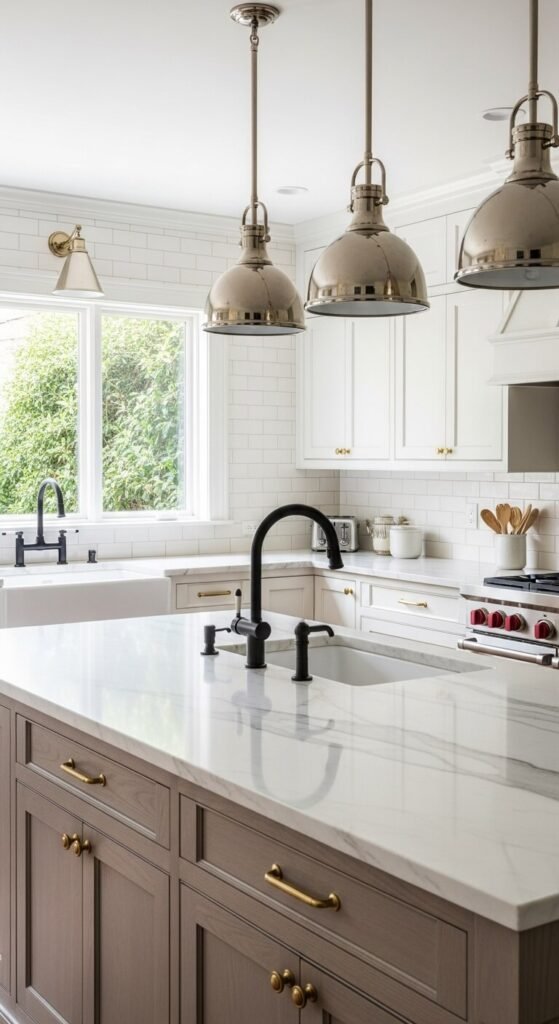
Understand the Warm-Cool Divide
Before you start mixing metals, you need to understand the single most important principle: the difference between warm metals and cool metals. Metals that share a temperature almost always look intentional together. Metals that clash in temperature can look accidental — unless you know exactly what you’re doing.
Warm metals:
- Brass and aged brass
- Gold and antique gold
- Bronze and oil-rubbed bronze
- Copper and rose gold
Cool metals:
- Polished nickel and satin nickel
- Chrome and polished silver
- Stainless steel
- Pewter
You can absolutely mix warm and cool metals — in fact, that contrast is often what makes a room feel dynamic and curated. But it helps to start with one temperature as your dominant tone and treat the other as an accent. That hierarchy is what keeps the mix looking deliberate rather than accidental.
Choose a Dominant Metal and Build From There
Every well-mixed metal scheme has a lead — one metal that appears most frequently throughout the space and sets the overall tone. Think of it as the anchor your eye returns to, with every other metal playing a supporting role.
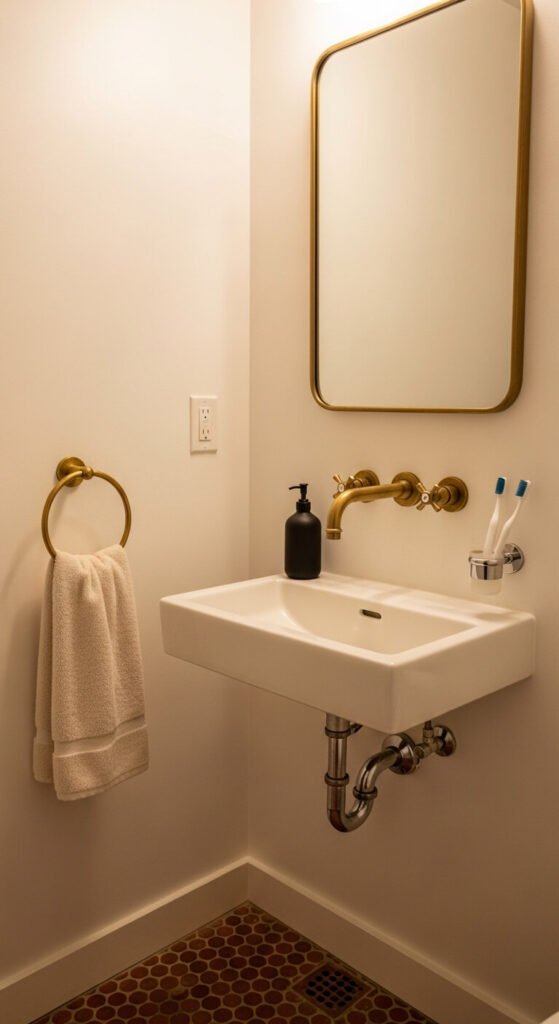
How to build your metal hierarchy:
- Dominant metal (60%) — appears in your largest and most visible hardware: faucets, light fixtures, cabinet pulls, door handles. This is the metal that defines the room’s personality.
- Secondary metal (30%) — appears in medium-scale elements: a mirror frame, a side table base, a curtain rod, picture frames, or decorative objects.
- Accent metal (10%) — just a touch, in the smallest details: a single decorative tray, a candle holder, the feet of a chair, the spine of a vase.
Stick to two to three metals maximum in any one room. Beyond that, even the most intentional mix starts to feel scattered.
Let Finish Do as Much Work as Tone
Here’s something most people overlook entirely: the finish of a metal matters just as much as its color. Two pieces in the same metal can look completely different depending on whether they’re polished, matte, brushed, hammered, or aged — and that variation in finish is actually one of your most powerful tools for making a mixed-metal scheme feel cohesive.
The golden rule of finish mixing: vary the finish within a metal family, or match the finish across different metals.
For example:
- A polished brass faucet + a brushed brass towel bar = variation within warm metals that feels collected and deliberate
- A matte black light fixture + a matte brass cabinet pull = different metals unified by their shared matte finish
- A hammered copper vase + a smooth bronze candlestick = different metals tied together by their similar warm, earthy tone
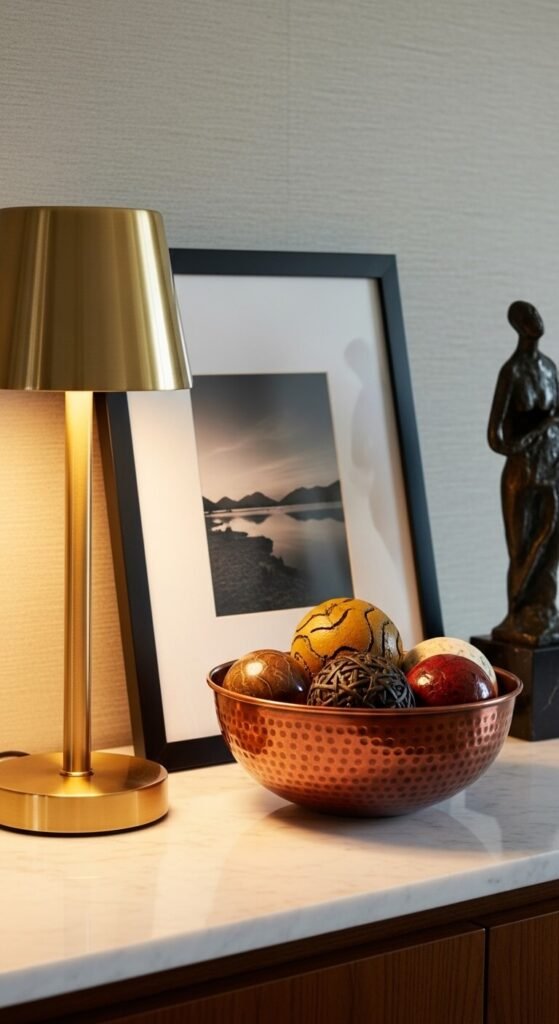
Finish creates texture and visual interest. Don’t be afraid to mix polished with matte, or hammered with smooth — as long as there’s a unifying logic to the choices.
Repeat Each Metal at Least Twice
One of the most important — and easiest — rules of mixing metals: whatever metal you introduce into a room, let it appear at least twice. A metal that shows up only once looks like an accident. A metal that appears in two or three different places looks like a decision.
This is called echoing, and it’s the technique that makes a mixed-metal space feel cohesive rather than chaotic.
Some examples of how echoing works in practice:
- Brass in the kitchen — cabinet hardware and the faucet and the pendant lights. Three appearances, one cohesive statement.
- Matte black in the bathroom — the mirror frame and the towel hook and the cabinet pull. Grounded and intentional.
- Brushed nickel in the living room — a table lamp base and a picture frame and a decorative tray. Subtle but unified.
The repetition creates a visual rhythm that your eye follows around the room — and that rhythm is what makes a space feel designed rather than decorated.
Know Which Metal Combinations Work Best
Some metal pairings are so reliably beautiful they’ve become classics. Others are more unexpected but equally stunning. Here’s a quick guide to the combinations that consistently work:
Timeless combinations:
- Brass + matte black — warm and grounding. Works in every style from modern farmhouse to contemporary glam.
- Brushed nickel + chrome — cool and crisp. Perfect for modern and Scandinavian-inspired spaces.
- Bronze + gold — rich and layered. Ideal for traditional, moody, or maximalist rooms.
More unexpected but stunning:
- Rose gold + gunmetal — warm meets industrial. Unexpectedly elegant in modern spaces.
- Copper + brass + black — a warm, rich trio that feels collected and artisanal.
- Antique silver + aged brass — patina-on-patina that feels deeply storied and curated.
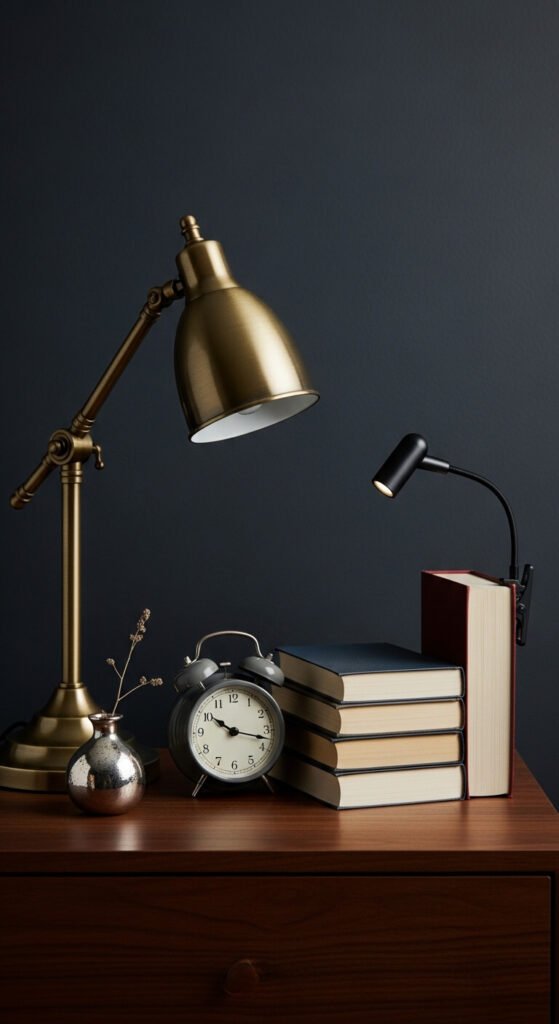
The Takeaway
Mixing metals is one of the most creatively satisfying things you can do in a room — and one of the easiest ways to make a space feel layered, sophisticated, and genuinely personal. Choose a dominant metal, echo each one at least twice, respect the warm-cool spectrum, and let finish do half the work for you.
Save this article before your next hardware or lighting purchase — because once you understand how to mix metals with intention, you’ll never look at a room full of perfectly matched fixtures the same way again. 🥇✨