
Full-room wallpaper commitment is not for everyone — and it doesn’t need to be. Some of the most stunning wallpaper moments in interior design happen on a single wall, inside a single nook, or wrapped around the inside of a bookcase. The secret that designers have always known is this: wallpaper used selectively hits harder than wallpaper used everywhere. When it appears in an unexpected, contained space, it surprises the eye, commands attention, and makes a room feel like someone genuinely thoughtful designed it. You get all the personality, all the drama, and all the beauty — without the overwhelming commitment of covering four walls and hoping for the best.
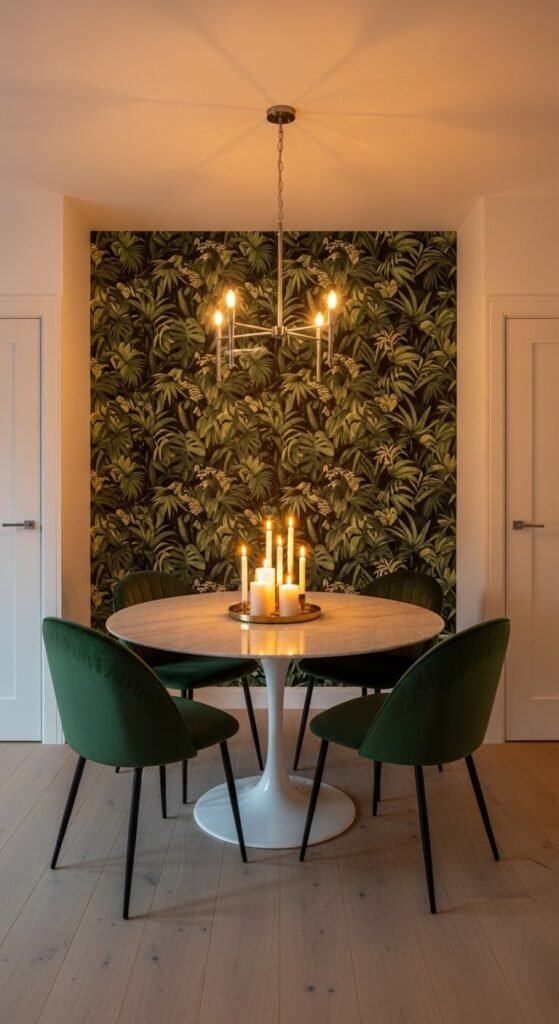
Whether you’re a renter working with peel-and-stick, a first-time wallpaper user, or simply someone who wants big impact with minimal risk, this guide walks you through the smartest and most beautiful ways to use wallpaper in small, strategic doses.
The Single Accent Wall: Bold, Contained, Unforgettable
The accent wall is the most accessible entry point into wallpaper decorating — and when it’s done with a genuinely beautiful pattern, it can be the most impressive design move in an entire room. The key is choosing the right wall and committing to a pattern bold enough to justify the moment.
Choosing the right wall for wallpaper:
- The wall you see first when you enter the room — the natural focal point
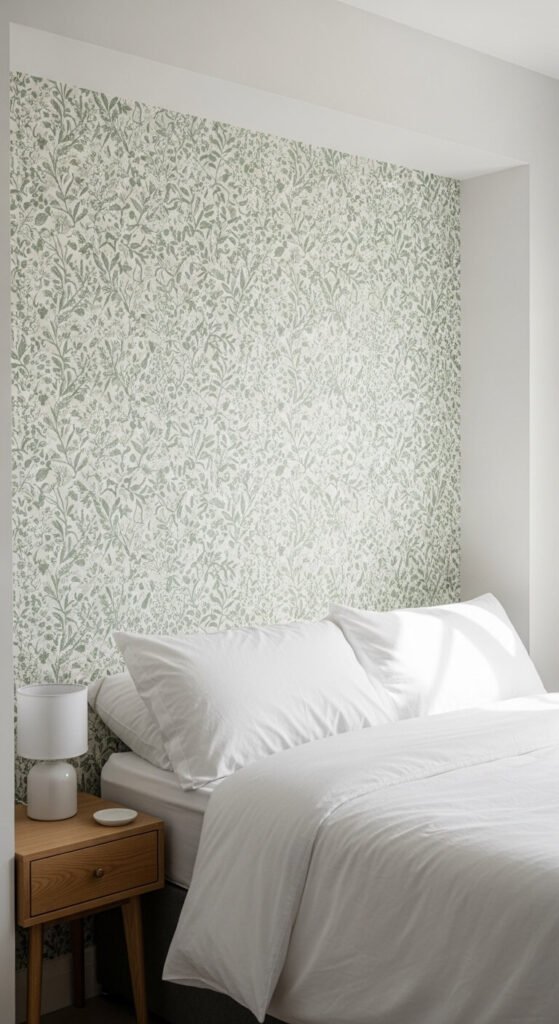
- Behind the bed in a bedroom — the headboard wall is the most traditional and most satisfying wallpaper placement; it frames the bed like a piece of art
- Behind the sofa in a living room — gives the seating arrangement a lush, layered backdrop
- The chimney breast if a fireplace is present — wallpapering just this protruding section creates a natural, architectural frame for the pattern
Pattern scale matters enormously here:
- On a single accent wall, you can go bigger and bolder than you’d dare with a full room; large-scale botanicals, oversized geometrics, and dramatic murals all work beautifully when contained to one wall
- Avoid small, busy patterns on accent walls — they lose their impact from a distance and can look restless rather than intentional
- If you’re choosing a patterned wallpaper for the first time, a single accent wall lets you live with it and love it before committing to the full room
Powder Rooms and Small Spaces: Go Wild Here
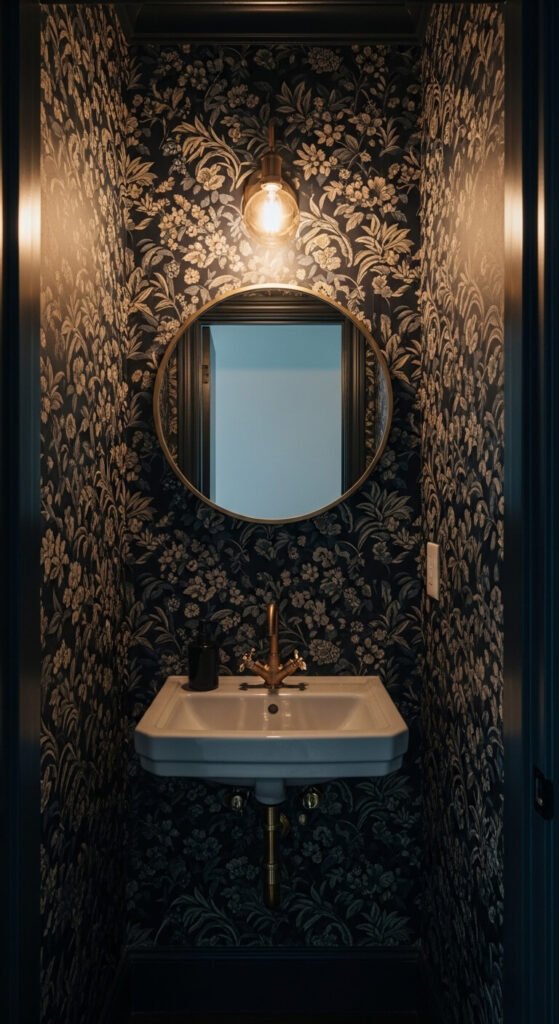
If there’s one room in the home where you can throw restraint out the window and let wallpaper be its most theatrical self, it’s the powder room. Small, enclosed, and visited in short bursts — it’s the perfect stage for a pattern you might never dare use anywhere else.
Why small spaces are wallpaper’s best friend:
- You need very little of it — a single roll often covers a small powder room entirely, making even premium wallpapers affordable
- The enclosed space amplifies the pattern rather than overwhelming the viewer; what would feel busy in a large room feels dramatic and immersive in a small one
- Guests experience it briefly and intensely — exactly the right conditions for maximum impression
Powder room wallpaper ideas worth exploring:
- Deep, moody florals with a dark background — midnight navy, forest green, or rich burgundy
- Bold geometric patterns in high-contrast colorways
- Maximalist, eclectic prints that feel too much for anywhere else — toile, chinoiserie, or vintage-inspired patterns
- A mural-style scenic wallpaper that tells a story around the entire room
Inside Cabinets and Bookshelves: The Surprising Detail
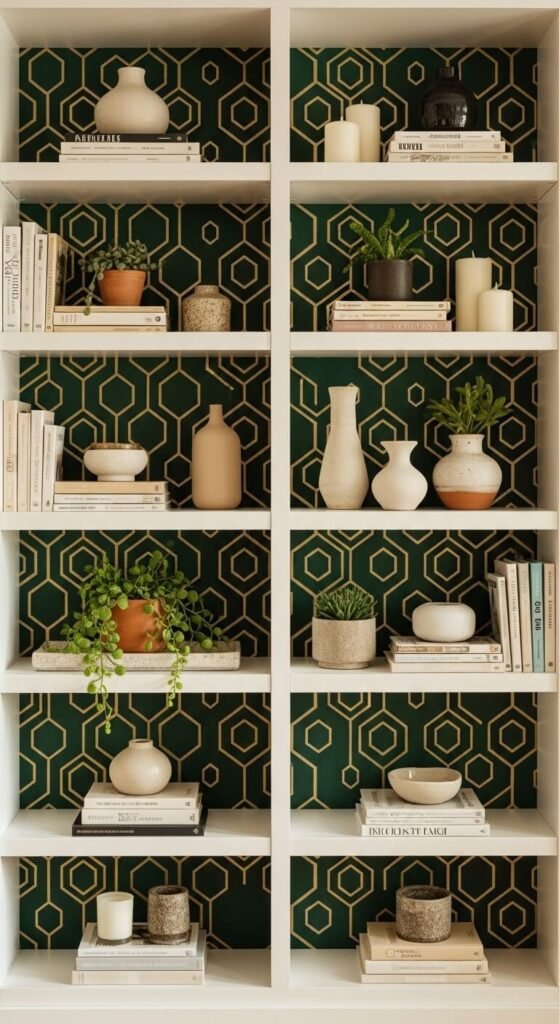
This is the wallpaper application that design-savvy visitors always notice and always ask about — because it’s unexpected, it’s refined, and it requires very little wallpaper to achieve a result that looks like it took significant effort.
Where to apply wallpaper for a hidden-gem effect:
- The back panels of an open bookcase — wallpaper the back wall of each shelf in a pattern that contrasts or complements the items displayed in front of it; the effect is layered, rich, and completely intentional-looking
- Inside kitchen cabinet glass doors — visible through the glass, a geometric or subtle pattern adds depth and personality to a kitchen without touching a single exterior surface
- The back of a hutch or china cabinet — a classic technique that makes displayed items look more curated and precious
- Inside a built-in alcove or niche — wallpaper the recessed back wall of any architectural niche to turn it from a simple indentation into a genuine focal moment
What patterns work best inside shelves:
- Geometric prints with enough repeat to look intentional even in small sections
- Textured or grasscloth-style wallpapers that add depth without a dominant pattern
- A contrasting solid or near-solid in a color that pulls from your room’s palette
Stair Risers: A Step-by-Step Transformation
Wallpaper on stair risers is one of those design details that stops people in their tracks — it’s charming, creative, and completely unexpected. Each riser becomes a tiny canvas, and the cumulative effect as you climb the staircase is genuinely delightful.
How to do it beautifully:
- Cut wallpaper strips to fit each individual riser — the vertical face of each step
- Use the same pattern on every riser for a cohesive, rhythmic effect; or alternate two complementary patterns for a more eclectic look
- Choose a pattern that’s small enough to be read clearly on a narrow surface — small geometric repeats, classic stripes, or delicate floral sprigs all work better than large-scale patterns on the limited riser height
- Seal with a matte varnish after application if the stairs see heavy foot traffic
The total amount of wallpaper needed for a standard staircase is surprisingly small — often less than a single roll — making this one of the most affordable high-impact wallpaper projects possible.
Peel-and-Stick: The Renter’s Permission Slip
For anyone in a rental or anyone who simply isn’t ready to commit to traditional paste-up wallpaper, peel-and-stick has genuinely arrived. The quality, the pattern selection, and the adhesion have all improved dramatically — and the ability to remove it cleanly without damaging walls makes every idea in this guide available to everyone.
Tips for peel-and-stick success:
- Clean the wall thoroughly with rubbing alcohol before application and let it dry completely — adhesion to dusty surfaces is significantly weaker
- Work from top to bottom and smooth out bubbles as you go with a squeegee or credit card
- Overlap seams slightly and press firmly to prevent lifting at the edges
- Remove slowly and at a low angle when the time comes — rushing removal is the most common cause of paint damage with peel-and-stick
One Wall, One Room, One Shelf at a Time
Wallpaper doesn’t ask you to go all-in. It asks you to find the one wall, the one room, or the one hidden surface that needs a moment — and then give it exactly that. The result is a home that feels layered, surprising, and entirely like you.
Save this guide before your next decorating project, share it with someone who’s been intimidated by wallpaper for too long, and go find the one small dose your home has been waiting for. 🌿✨