
The mudroom has one of the hardest jobs in the entire house. It’s the decompression chamber between the outside world and the sanctuary of home — the place where backpacks land, boots get kicked off, wet umbrellas drip, and dog leashes pile up alongside sports equipment and grocery bags. Done poorly, it amplifies the chaos rather than containing it. Done well, it does something remarkable: it absorbs the mess so the rest of your home never has to. And the best mudrooms manage to look genuinely beautiful doing it — organized, warm, and welcoming, even on the messiest Tuesday afternoon you can imagine.
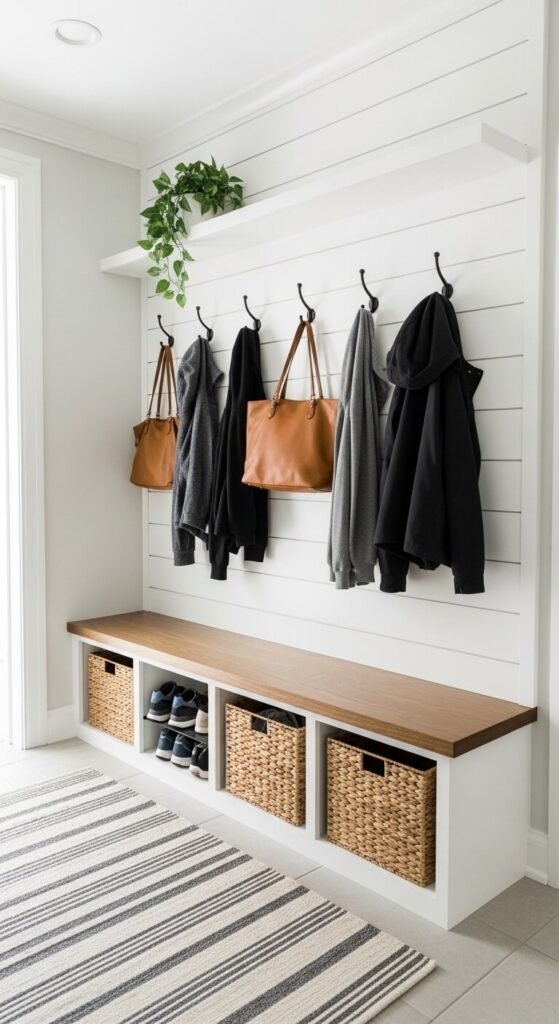
Whether you’re working with a dedicated mudroom, a side-entry hallway, or just a corner near the back door that desperately needs structure, this guide covers every element you need for a space that contains the chaos and looks great doing it.
Start With the Non-Negotiables: Hooks, Seating, and Storage
Every functional mudroom — regardless of size, style, or budget — is built on three foundational elements. These are the non-negotiables that make a space actually work for real daily life. Skip any one of them and the system breaks down.
1. Hooks — more than you think you need
Hooks are the backbone of a mudroom. Every person who uses the space regularly needs at least two hooks — one for a coat, one for a bag — and ideally a third for extras. The height matters too: main hooks at adult coat height (around 60 to 66 inches from the floor), and a lower row at 42 to 48 inches for children or shorter items.
- Double hooks are more efficient than single and take up the same wall space
- Heavy-duty hooks rated for actual coats and bags are worth the investment; decorative hooks that can’t hold real weight are a frustration waiting to happen
- Consistent finish throughout — all matte black, all brass, all brushed nickel; mixing hardware finishes in a functional space looks unfinished
2. Seating — for putting shoes on and taking them off
A bench, a built-in seat, or even a sturdy stool is essential for the simple act of dealing with footwear without hopping on one foot. It’s also where bags get set momentarily and where kids do their homework while waiting.
3. Storage — for everything that can’t hang on a hook
Shoes, sports gear, reusable bags, seasonal accessories — these all need a home that isn’t the floor. Cubbies, baskets, cabinets, or open shelving: any of these work as long as the system is consistent and genuinely used.
Choose Flooring and Wall Finishes That Hide Real Life
A mudroom is not the place for light-colored grout, delicate finishes, or anything that requires careful handling. The materials here need to be genuinely durable — able to withstand wet boots, muddy paws, dropped bags, and daily traffic without looking tired within a year.
Flooring that works hard and looks great:
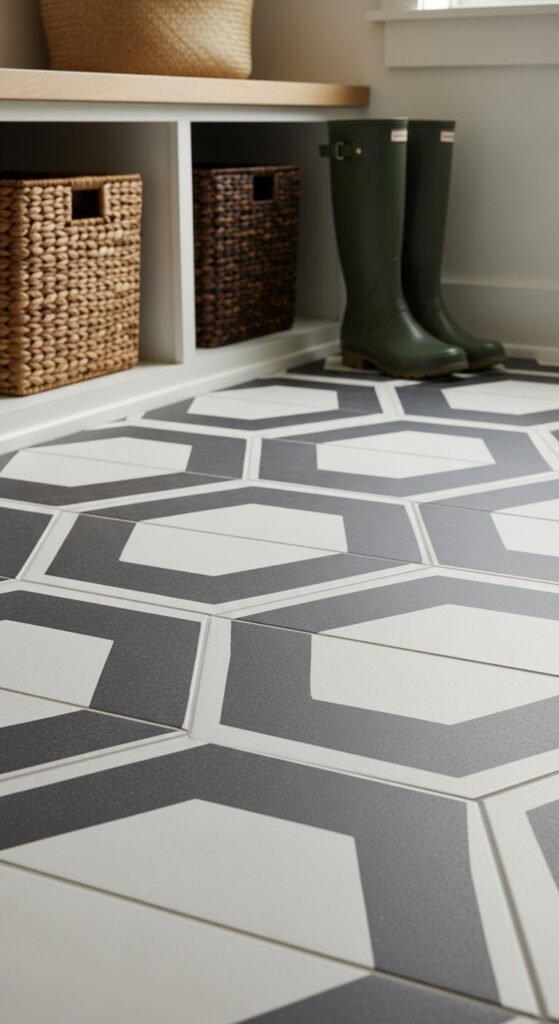
- Large-format tile in a mid-tone or patterned option — easy to mop, hides dirt between cleanings, and feels clean and purposeful
- Luxury vinyl plank — waterproof, scratch-resistant, warmer underfoot than tile, and available in beautiful wood-look finishes
- Cement or encaustic tiles — incredibly durable and deeply beautiful; the pattern hides dirt and adds personality simultaneously
- A washable runner rug over hard flooring — adds warmth and softness while remaining completely practical; look for flatweave styles that can go in the washing machine
Wall finishes built for impact:
- Shiplap or board and batten — adds architectural character, hides minor scuffs better than flat paint, and photographs beautifully
- Semi-gloss or satin paint — easier to wipe down than flat or matte; a non-negotiable finish choice for a space this high-traffic
- Tile or beadboard wainscoting on the lower half of the wall — creates a washable zone exactly where boots and bags make contact most
Build a Personalized Station for Each Family Member
The most functional mudrooms aren’t just organized — they’re personalized. When every person who uses the space has their own designated zone, the system works automatically because there’s no ambiguity about where anything belongs.
How to create individual stations:
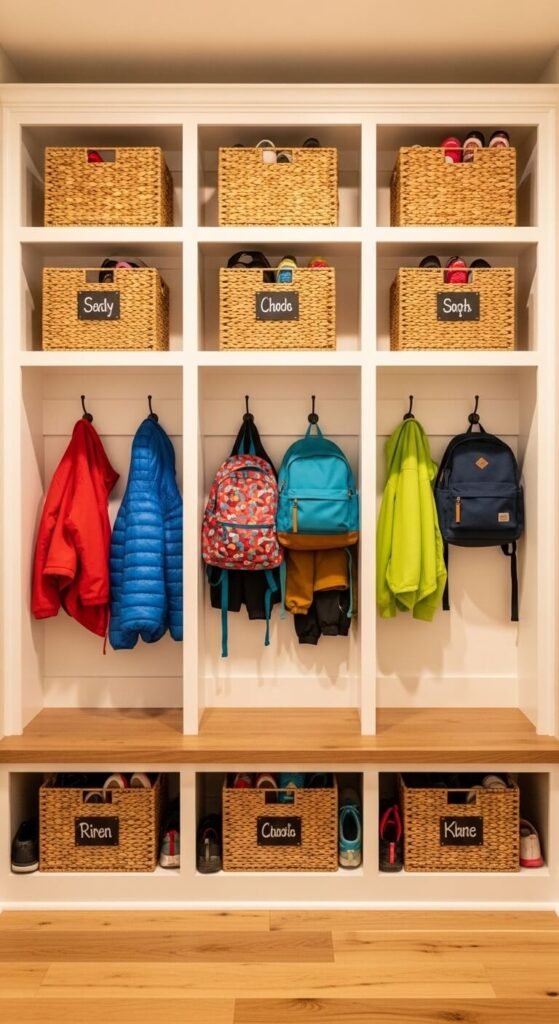
- Assign a section of hooks to each person — their coat hook, their bag hook, their sport hook; label with names for younger children or simply establish by position
- Give each person their own cubby or basket — shoes, sports gear, and personal items stay in the designated spot; when the basket is full, that person knows it’s time to edit
- Color-code if it works for your family — different colored baskets, labels, or even different hook styles for each person can simplify the sorting process without any additional effort
For families with pets:
- A dedicated hook or drawer for leashes, waste bags, and pet accessories at a height that’s accessible but separate from family items
- A small rug or mat near the entry specifically for paw wiping
- A basket or cabinet for grooming tools and outdoor pet gear
Add the Decorative Layer That Makes It Feel Like Home
Function without beauty is a utility room. Beauty without function is a photo shoot. The mudroom that works and looks great achieves both — and the decorative layer is what lifts the functional bones into something you’re genuinely happy to walk into every day.
Decorative touches that survive a mudroom:
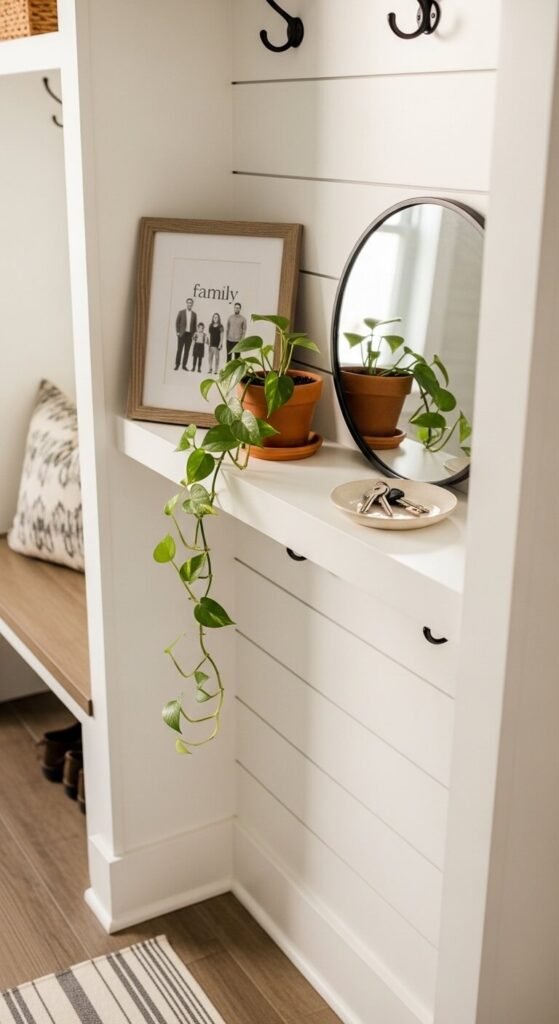
- A framed print or small piece of art at eye level above the bench — even one simple print signals that this space was designed, not just assembled
- A small plant or trailing greenery on a floating shelf — choose something hardy like a pothos or snake plant that tolerates the occasional neglect that a busy entry zone guarantees
- A mirror — practical for a final check before leaving and visually enlarges a narrow space; choose a style that suits the overall aesthetic from simple and clean to decorative and ornate
- A small tray or bowl for keys and mail on a narrow shelf or console — keeps daily-use items accessible without scattering across every surface
- Seasonal touches — a wreath on the wall, a small seasonal arrangement on the shelf; these small rotations keep the space feeling alive and connected to the time of year
The Space That Saves the Rest of Your Home
A well-decorated mudroom doesn’t just contain the chaos at the door — it prevents it from ever reaching the living room, the kitchen, or the bedroom. Every coat on its hook, every shoe in its basket, every bag in its cubby is one less thing disrupting the calm of the spaces beyond. The investment in getting this entry zone right pays dividends in every other room in the house.
Save this guide for your next organizational project, share it with a fellow parent or pet owner who’s been fighting the entry chaos battle, and go build a mudroom that finally works as hard as your family does. 🧥✨