
Your fireplace mantel is prime real estate—it’s literally the first thing people see when they walk into your living room. Yet so many mantels are either completely bare (wasted potential!) or cluttered with random objects that create visual chaos instead of charm.
A well-styled mantel transforms your entire room. It sets the tone, anchors your design scheme, and creates that magazine-worthy moment that makes guests wonder if you secretly have a designer on speed dial.
The secret? There’s a proven formula for mantel styling that works every single time. It’s not about having the most expensive decor or the biggest collection of objects. It’s about understanding layers, height variation, balance, and negative space. Master these principles and your mantel will become the stunning focal point your room deserves.
Start With A Statement Anchor Piece
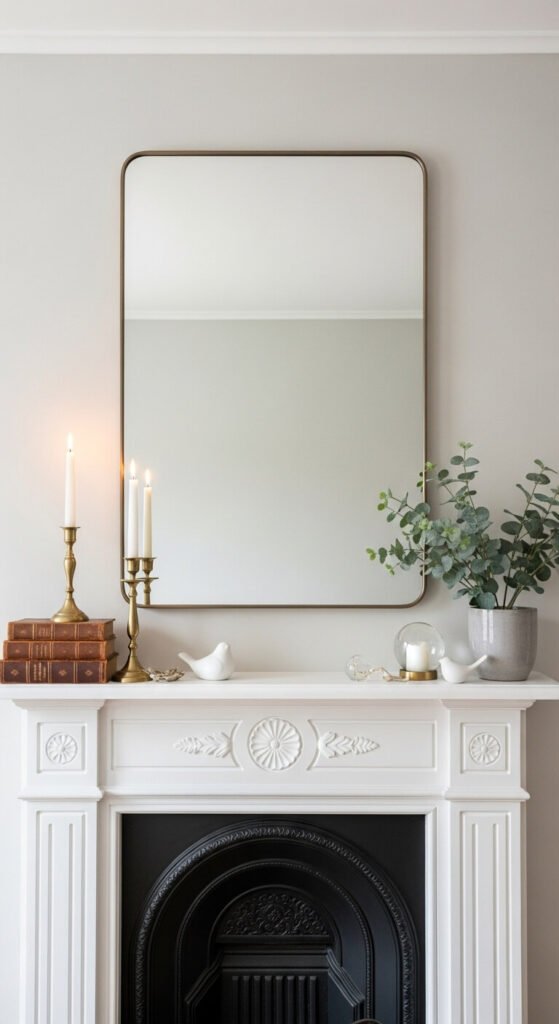
Every great mantel begins with one substantial piece that grounds the entire arrangement and gives your eye somewhere to land.
Anchor piece options:
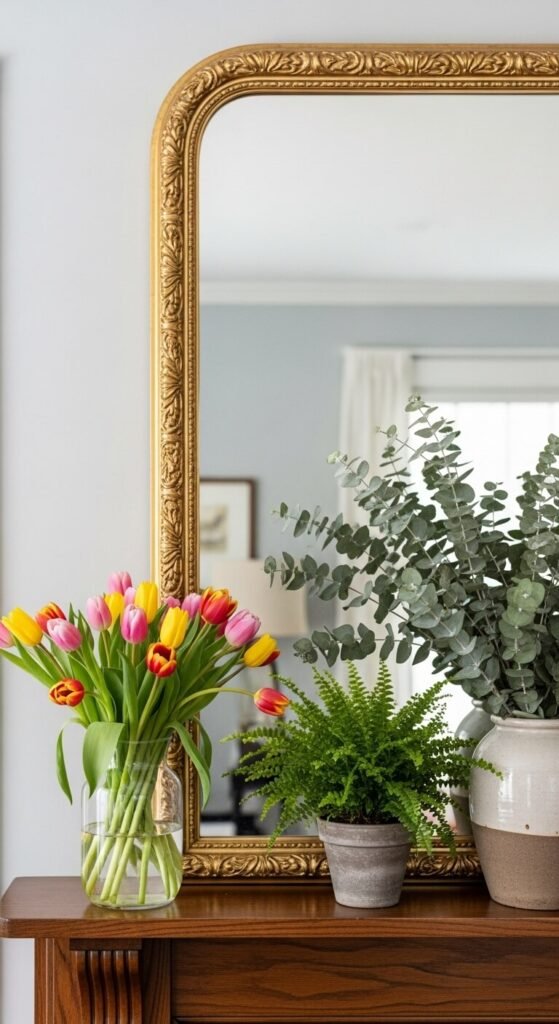
Mirrors (the most popular choice):
- Large framed mirror centered above the mantel
- Should be 2/3 the width of the fireplace opening
- Reflects light and makes the room feel larger
Artwork:
- Large framed print or painting
- Multiple smaller pieces arranged in a gallery style
- Leaning art creates a more casual, layered look
Other statement pieces:
- Large clock
- Architectural salvage piece
- Oversized wreath (seasonal)
- Large vintage window frame
Your anchor sets the style direction for everything else. Modern mirror? Keep the rest contemporary. Ornate gold frame? You can embrace traditional or eclectic styling. This piece is your north star.
Layer Objects Using The Triangle Method
Professional stylists use an invisible triangle technique to create visual balance. Imagine connecting your three main object groupings with lines to form a triangle.
How to apply the triangle method:
- Place your tallest object on one end (vase with branches, tall candlestick, tall sculpture)
- Add a medium-height grouping in the middle or opposite side (stack of books, medium vase, decorative bowl)
- Include a low, wider object to complete the triangle (plants, small bowls, candles)
The triangle prevents that “everything’s the same height” problem that makes mantels look flat. Your eye should travel up, across, and down through the arrangement naturally.
This doesn’t mean three items only—you’ll have multiple triangles overlapping within your overall design. It’s about creating varied height throughout rather than a rigid three-object rule.
Embrace Asymmetrical Balance (Not Perfect Symmetry)
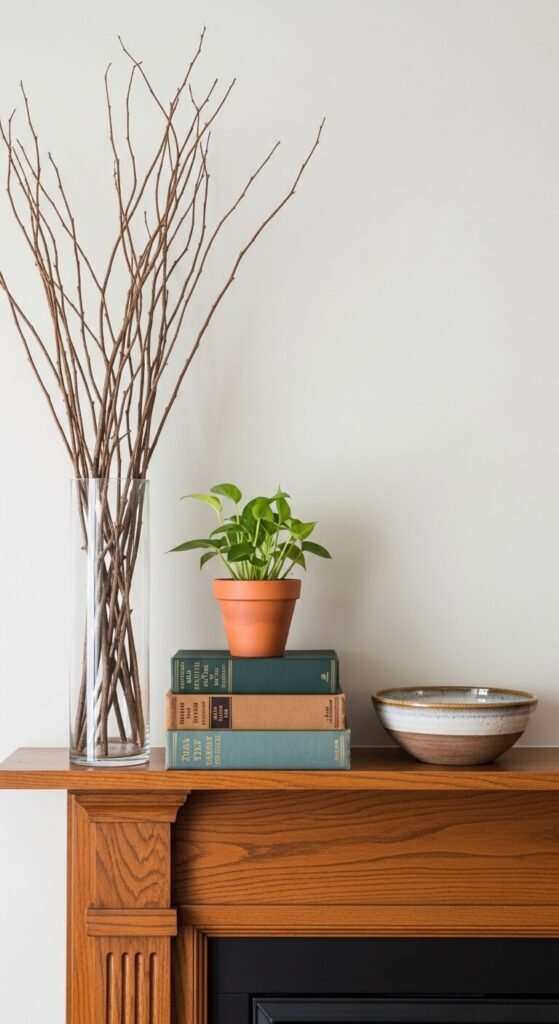
Forget the matching candlesticks on each end like it’s 1995. Modern mantel styling uses asymmetrical balance, which feels more organic and interesting while still appearing intentional.
Asymmetry done right:
Instead of: Two identical tall candlesticks flanking a mirror Try: One tall vase on the left, a grouping of three varied objects on the right
Instead of: Matching picture frames on each end Try: One large framed piece leaning on one side, a sculptural object on the other
The key: Objects don’t match, but they balance in visual weight. A tall, narrow vase on one side balances with a wider, shorter grouping on the other. Your eye shouldn’t feel pulled to one side more than the other.
How to check: Squint at your mantel. If one side feels noticeably “heavier” or busier, redistribute objects until it feels balanced.
Use The Rule Of Three (And Odd Numbers)
Just like with coffee table styling and throw pillows, odd numbers create more dynamic, natural-looking arrangements than even numbers.
Apply the odd number rule:
- Three candlesticks of varying heights
- Five small objects grouped together
- One large centerpiece with objects on either side (total of 3, 5, or 7 groupings)
- Seven small vases or bottles clustered together
Why odd numbers work: They prevent that overly matchy, formal feeling. Even numbers naturally create pairs, which feels stiff. Odd numbers force asymmetry and visual interest.
Exception: If you’re going for a very formal, traditional look, symmetrical pairs work beautifully. But for most contemporary spaces, embrace the odd.
Layer Forward And Backward For Depth
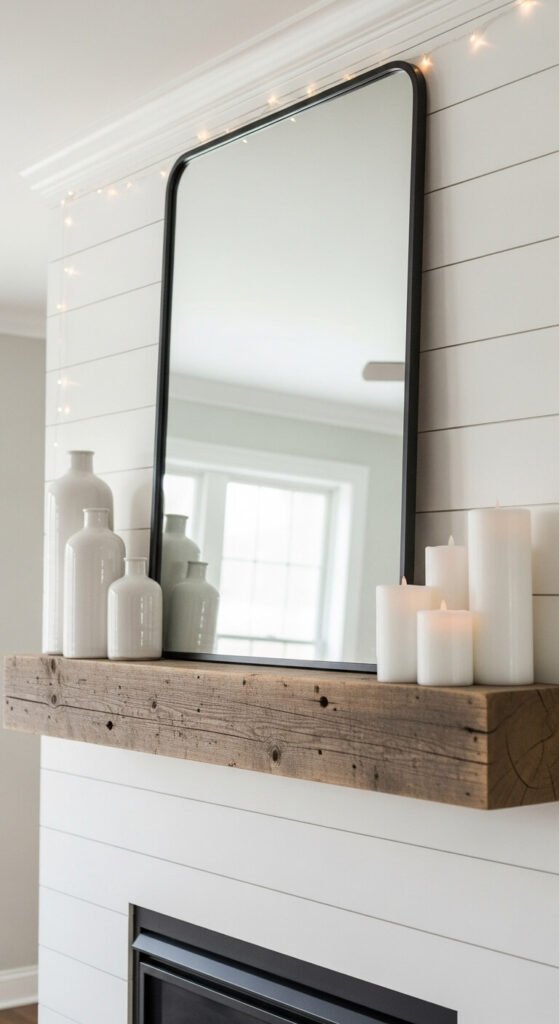
Flat mantels are boring mantels. Creating depth by layering objects at different distances from the back wall makes your styling look professional and dimensional.
Layering strategy:
Back layer: Against the wall
- Large anchor piece (mirror, art, wreath)
- Tall objects that need the support
Middle layer: A few inches forward
- Medium-height objects
- Leaning smaller frames or art
- Books stood upright or stacked
Front layer: Near the mantel edge
- Smaller decorative objects
- Candles
- Low bowls or plants
- Objects that balance toward the front
This front-to-back layering creates “rooms” within your mantel and prevents the one-dimensional lineup effect. It also allows you to see multiple objects at once rather than everything being hidden behind the front row.
Mix Textures And Materials
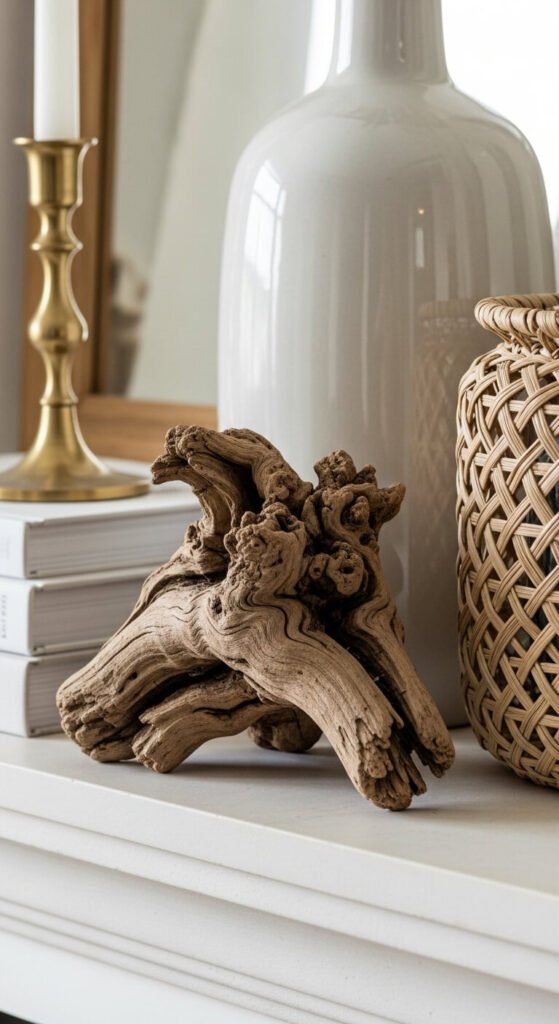
Variety in texture is what makes mantels feel rich and curated. Combining different materials prevents your styling from feeling monotonous, even if you stick to a limited color palette.
Texture combinations:
Natural elements:
- Wood (driftwood, branches, wooden bowls)
- Stone or ceramic
- Plants (fresh or dried)
- Woven baskets
Metals:
- Brass candlesticks or frames
- Copper vessels
- Iron sculptures
- Silver trays
Soft elements:
- Books with fabric covers
- Woven textiles draped casually
- Natural fiber elements
Smooth elements:
- Glass vases or hurricanes
- Polished ceramics
- Mirrors
Aim for at least 4-5 different textures across your mantel. The variety creates visual interest that keeps the eye engaged.
Stick To A Cohesive Color Palette
Even eclectic mantels need color restraint. Limiting your color palette to 2-3 colors plus neutrals creates cohesion that looks intentional rather than random.
Color palette approaches:
Neutral and natural:
- Whites, creams, beiges, and natural wood
- Add greenery as the only color
- Timeless and versatile
Monochromatic:
- Varying shades of one color (all blues, all greens)
- Creates drama through tone variation
- Sophisticated and cohesive
Neutral + one accent color:
- White, cream, and wood PLUS navy blue
- Grays and whites PLUS warm terracotta
- Most common and easiest to execute
Bold and eclectic:
- 3 distinct colors that complement each other
- Requires more skill to balance
- Best for collected, maximalist styles
Your mantel colors should pull from your room’s existing palette. If your throw pillows are blue and gold, echo those tones on your mantel for a connected, designed look.
Leave Breathing Room (The 60% Rule)
The biggest rookie mistake? Overcrowding the mantel until there’s no visual rest. Professional styling requires negative space.
The breathing room guideline:
- Style only 60-70% of your mantel’s surface
- Leave empty space between object groupings
- Don’t line objects edge-to-edge
- Allow your anchor piece to breathe
Negative space serves several purposes:
- Lets each object be appreciated individually
- Prevents overwhelming visual clutter
- Makes your styling feel intentional, not accidental
- Easier to keep clean and dust
If your mantel feels too busy, start removing items one by one. Usually, less is more. The items that remain will have more impact when they’re not competing for attention.
Add Greenery For Life And Color
Plants and natural elements are the secret ingredient that brings mantels to life and prevents them from feeling stale or static.
Greenery options:
Fresh options:
- Small potted plants (succulents, herbs, small houseplants)
- Fresh flower arrangements
- Branches with leaves (eucalyptus, olive branches)
Dried options (low maintenance):
- Pampas grass in tall vases
- Dried wheat or grasses
- Preserved eucalyptus
- Dried flowers
Seasonal options:
- Spring: tulips, cherry blossoms
- Summer: fresh greenery, bright flowers
- Fall: branches with autumn leaves, mini pumpkins
- Winter: evergreen branches, white branches, pinecones
Even one small plant or vase of branches transforms a mantel from “decorated” to “living and breathing.” This organic element softens hard edges and adds that fresh, current feeling.
Style For The Seasons (Easy Swaps)
The beauty of mantel styling is how easily you can refresh it seasonally without starting from scratch.
Year-round base elements (keep these):
- Your anchor piece (mirror or large art)
- Larger structural elements (tall candlesticks, substantial vases)
- Books (unless you want to swap covers)
Seasonal swap elements (change these):
- Greenery and florals
- Small decorative objects
- Candles (swap colors and scents)
- Small accent pieces
This approach means you’re not re-styling from zero four times a year. You’re just swapping out 3-5 smaller elements while maintaining your overall structure and style. It’s efficient, budget-friendly, and keeps your mantel feeling fresh and current.
Adjust For Your Mantel Size And Shape
Not all mantels are created equal. Your styling approach should adapt to your specific mantel dimensions.
Styling by size:
Narrow mantels (4-6 inches deep):
- Use smaller objects that won’t fall off
- Lean art against the wall rather than placing objects forward
- Prioritize height over depth
- Consider wall-mounted elements above
Standard mantels (6-8 inches deep):
- Full range of styling options available
- Can layer forward and backward comfortably
- Most versatile for styling
Deep mantels (10+ inches):
- Can create multiple layers front to back
- Risk of looking empty if under-styled
- Group objects to fill space without clutter
- Consider larger-scale pieces
Long mantels:
- Create 2-3 distinct styling zones
- Anchor piece in center, balanced groupings on ends
- Don’t spread objects too thin
Short mantels:
- Keep it simple with fewer, larger pieces
- One strong grouping is better than many small ones
Ready to transform your mantel into a stunning focal point? Start with a strong anchor piece, embrace asymmetrical balance, and remember to leave breathing room between your carefully chosen objects. Your mantel is about to become the design moment your living room has been waiting for. Save this guide for your next seasonal refresh—you’ll come back to it again and again! 🔥✨