
The environment you work in directly shapes how you work. This is not a preference — it is backed by decades of environmental psychology research showing that light quality, color, visual complexity, and even the materials on a desk surface all measurably affect focus, creative output, and the ability to sustain concentration across a working day. Most home offices are decorated by default rather than by design: whatever was already in the spare room, whatever desk was cheapest, whatever chair happened to fit. The result is a space that feels like a compromise — and working in a compromise every day gradually reinforces the feeling that the work itself is a compromise. You deserve a home office that tells your brain, every time you sit down, that this is a space where good work happens.
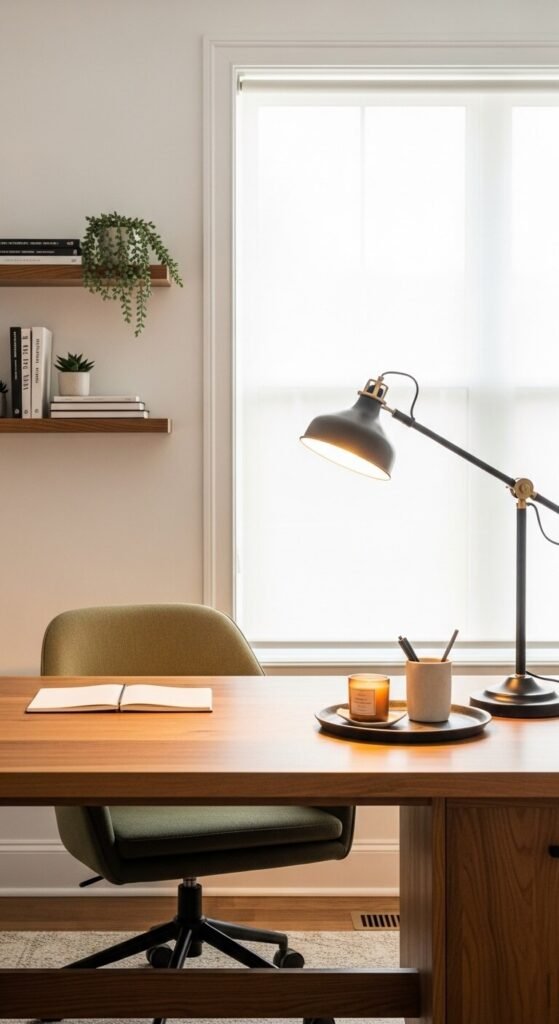
Here is exactly how to design a home office that makes you genuinely want to sit down and work.
Position the Desk for Maximum Natural Light
Light is the single most impactful environmental variable in a working space — and the position of the desk relative to natural light sources determines how your eyes, mood, and energy perform across the entire working day.
The optimal positions:
- Beside a window (perpendicular to it) — the best position for most workers. Natural light hits the desk and the face from the side without creating glare on the screen. This is the position used in the majority of professionally designed home offices.
- Facing a window — good for natural light on the face but creates screen glare in bright conditions. Use a sheer curtain to diffuse without blocking.
- Back to a window — the worst position. The light source behind you creates glare on the screen and a shadow on the work surface.
Add task lighting for evenings and low-light days:
A desk lamp positioned to the left of the screen (for right-handed workers) at a 45-degree angle provides focused, non-glare task lighting. A warm white bulb at 2700K to 3000K reduces eye strain and maintains the warm atmosphere of the room rather than introducing a cold, clinical light source.
Choose a Wall Color That Works for Your Work
Color has a measurable and consistent effect on cognitive performance — and different types of work benefit from different color environments.
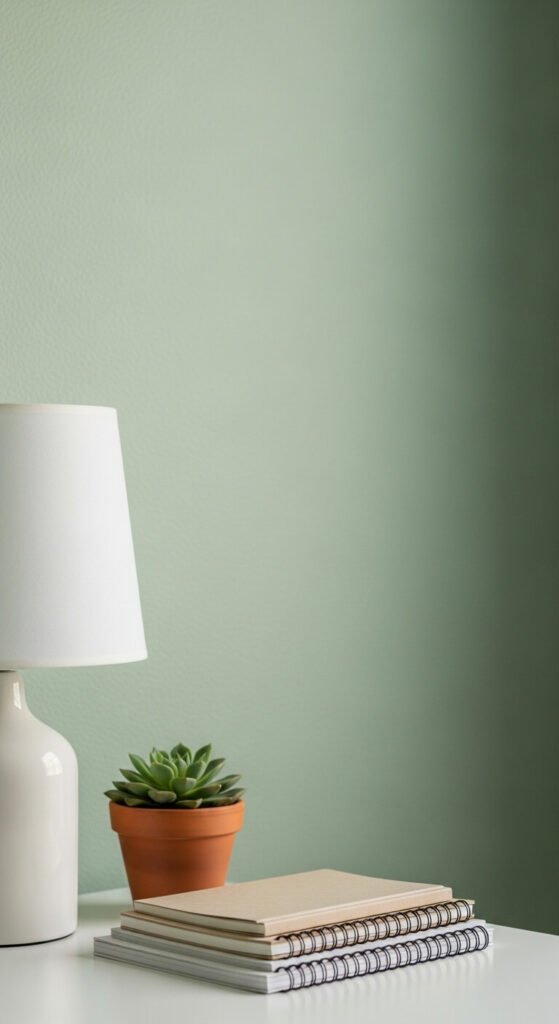
Color by work type:
- Deep focus and analytical work: Muted blues, soft greens, and warm greiges — these colors lower the sympathetic nervous system activation and support sustained concentration. Sage green is the most commonly specified office color in contemporary interior design for exactly this reason.
- Creative work: Warm terracotta, dusty mustard, and warm amber tones — warm colors are associated with expanded thinking, lower inhibition, and higher creative ideation scores in environmental studies.
- Neutral and flexible: Warm white or cream — the most versatile choice that works for any type of work without imposing a specific cognitive environment.
What to avoid: Bright saturated colors — vivid red, electric blue, bright yellow — are stimulating rather than focusing and produce mental fatigue more quickly during sustained work sessions.
Build a Desk Surface That Supports How You Actually Work
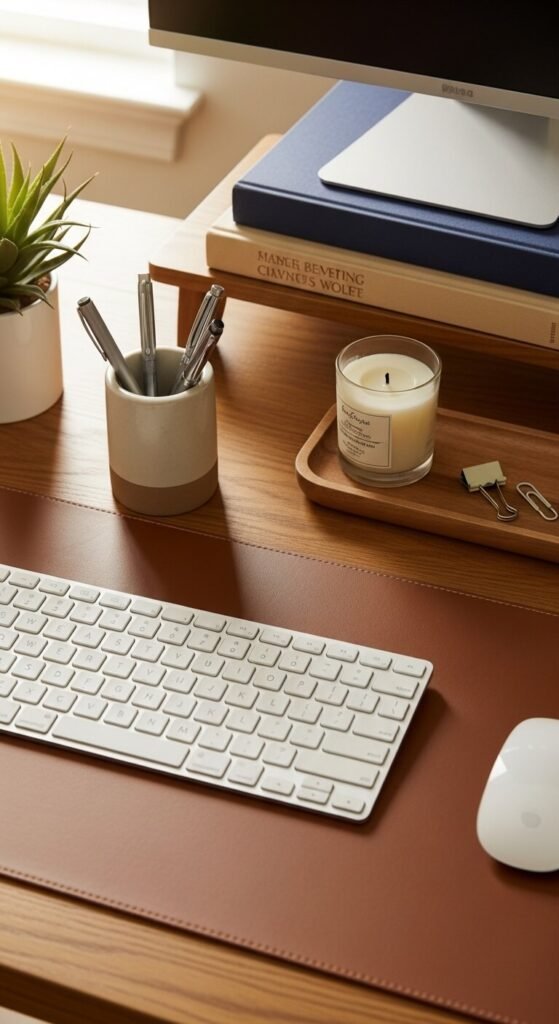
The desk surface is the environment closest to where your hands, eyes, and focus operate for the entire working day. It deserves more deliberate attention than any other surface in the office.
The functional desk surface formula:
- A desk pad or leather mat centered in the primary work area — creates a defined zone for active work and protects the desk surface
- One pen holder with only the pens actually used daily — a pen holder with twelve pens is visual clutter; a pen holder with three pens is a functional object
- A small plant — multiple studies have linked the presence of a living plant on a desk surface with measurable improvements in concentration and self-reported well-being during working hours
- Task lighting positioned to the non-dominant side
- A tray containing the two or three non-work objects that live on the desk — a candle, a personal item, a small object — so they are contained rather than scattered
Remove from the desk surface:
- Anything that belongs to a task you are not currently working on
- Any paper that has not been filed
- Chargers and cables — route them behind the desk or under the desk pad
Add Shelving That Functions and Inspires
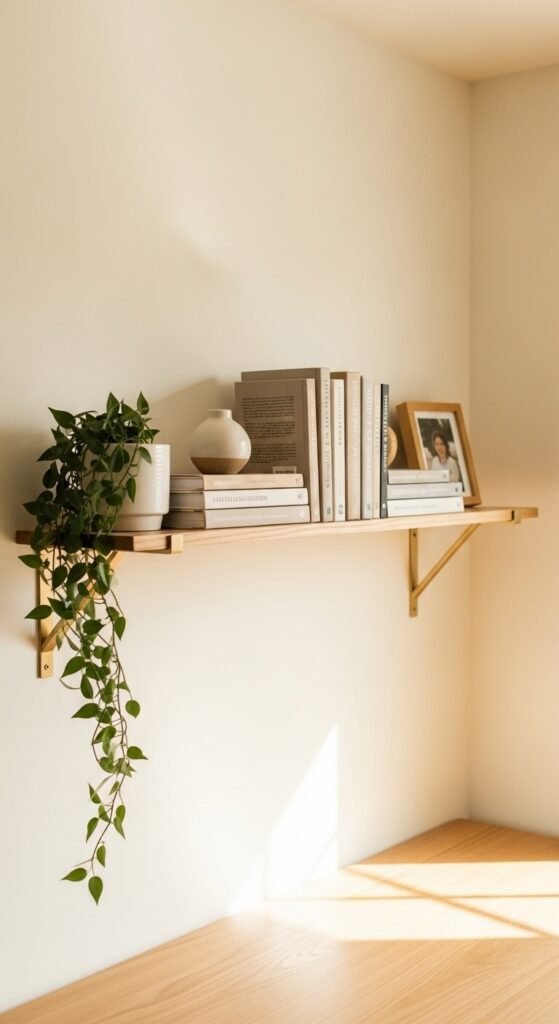
Floating shelves above or beside the desk serve two purposes that wall art alone cannot — they provide accessible storage for reference materials and create a personal visual environment that communicates something about the person working in the space.
The shelf styling formula for a home office:
- Two-thirds books and work materials, one-third decorative objects — a shelf that is entirely books looks like a library; a shelf that is entirely decorative looks like a display case. The mixture looks like someone works and lives here.
- Vary heights — stack some books horizontally as risers, stand others vertically, and leave small gaps for objects at different heights
- Include one living plant per shelf — a trailing pothos, a small succulent, or a single fern adds the organic presence that is consistently linked to reduced stress in work environments
- Keep one shelf partially empty — intentional negative space on a shelf communicates restraint and prevents the visual complexity from overwhelming the calm working environment
Control What the Eye Rests on Between Tasks
One of the most overlooked aspects of home office design is what happens in the visual field during the brief pauses between focused work — the moment you look up from the screen, the view that greets you between tasks.
Research consistently shows that brief exposure to nature elements, open space, or calm visual scenes during cognitive rest periods measurably restores attention capacity faster than visual complexity or screen-based rest.
Practical applications:
- Position the desk so the view when looking up from the screen is a window, a plant, or a calm piece of art — not a wall of files, a pile of post, or a television
- Keep one wall in the office entirely free of objects — a calm empty wall that rests the eye between tasks
- Use a single meaningful piece of art rather than a gallery wall — one piece gives the eye a destination; a gallery wall provides too much visual information for the resting brain
The Office That Does the Work Before You Do
A well-designed home office removes friction. When the light is right, the desk surface is clear, the color is calming, and the visual environment is quiet enough to think in, sitting down to work feels easier rather than like a discipline. The space itself begins to signal focus before the first task is opened.
Start with one change — the desk position, the wall color, or the desk surface — and build from there. Each improvement compounds.
Save this and pin it as your home office design guide — because the space you work in shapes the work you produce, and this is worth getting right.