
Open-plan living sounds like a dream — until you’re sitting in your “living room” that bleeds into your “dining room” that bleeds into your “home office” and the whole thing feels like one enormous, slightly chaotic room with no beginning and no end. Open floor plans are genuinely wonderful for light, flow, and a sense of spaciousness. But without some intentional structure, they can also feel directionless and hard to live in — like the furniture is just floating in a sea of square footage with nowhere particular to belong. The good news? You don’t need a contractor, a permit, or a single wall to fix this. You just need to understand the art of zone-making.
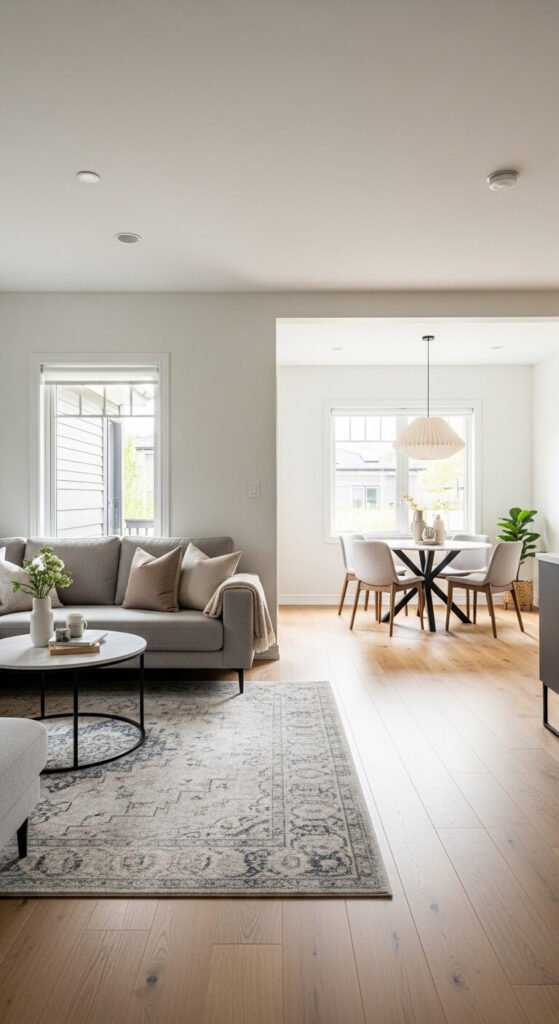
Zoning is the practice of using visual and physical cues — rugs, lighting, furniture arrangement, color, and more — to create distinct areas within a shared space. Done well, it gives every zone its own identity and purpose without sacrificing the openness that makes the floor plan worth having.
Zone With Rugs First — It’s the Fastest Move
If you take one technique from this entire guide, let it be this: a rug defines a zone better than almost anything else. The moment you place a rug under a furniture grouping, that area becomes its own world. It has an edge. It has a boundary. It communicates clearly: this is where the living room begins and ends.
How to use rugs for zoning:
- One rug per zone — each area in the open plan gets its own rug in its own appropriate size; the living zone gets a large area rug under the sofa and coffee table, the dining zone gets a rug under the table that extends far enough for chairs to remain on it when pulled out
- Keep rugs in the same color family — they don’t have to match exactly, but they should feel like they belong to the same home; a unified palette across multiple rugs prevents the space from feeling scattered
- Vary the texture — a flat-woven rug under the dining table and a plush or textured rug in the living zone creates visual differentiation while keeping the palette cohesive
- Size up generously — the most common rug mistake in open-plan spaces is choosing a rug that’s too small; when the rug is too small, the furniture floats above it and the zone fails to register
In an open plan, rugs are your invisible walls — and they work.
Anchor Each Zone With a Dedicated Light Source
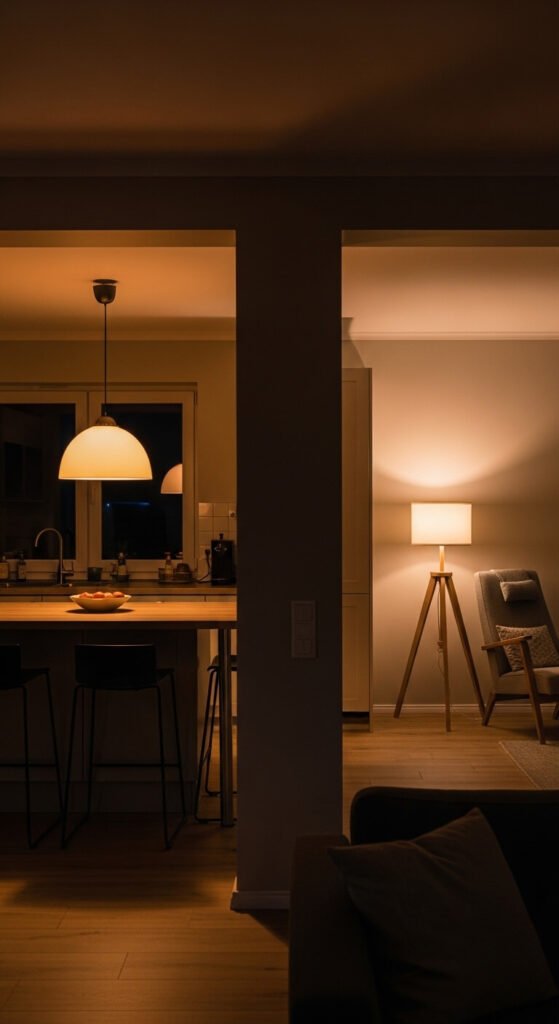
Look up at the ceiling of any well-designed open-plan space and you’ll immediately understand the zoning at play — because each zone has its own light source directly above it. Lighting is one of the most powerful zoning tools available, and it works from above in a way that furniture and rugs can’t replicate.
Lighting strategies that define zones:
- A statement pendant or chandelier over the dining table is the clearest zone-marker in any open plan; it anchors the table visually and declares: this is the dining zone
- Recessed lighting on separate circuits allows you to control the brightness of each zone independently — bright over the kitchen, warm and dim over the living area
- A floor lamp placed at the edge of a seating arrangement creates a soft pool of light that reinforces the boundary of the living zone, especially in the evening
- Track lighting directed at specific zones gives you flexibility to shift the focus as your layout evolves
When each zone is lit differently, the space reads as multi-room even without a single dividing wall.
Use Furniture Arrangement to Build Invisible Boundaries
The way you arrange furniture is one of the most powerful zoning tools you have — and it costs nothing if you’re working with pieces you already own. The key insight is this: furniture doesn’t have to face the same direction or float against the walls. Placed strategically, it creates its own architecture.
Furniture arrangement principles for open plans:
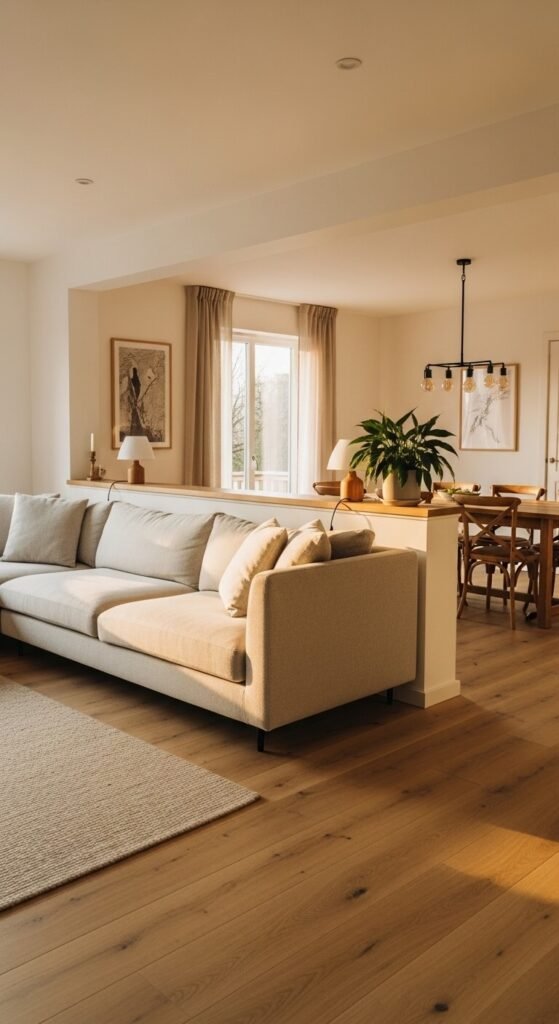
- Float your sofa away from the wall and turn it slightly so its back faces the dining area; this creates a natural partition between zones while keeping the space open
- Use a sofa table or console behind the sofa — a narrow table placed along the sofa’s back edge acts as a soft room divider while providing a surface for lamps, plants, and objects that face the dining side
- Position furniture to face inward within each zone — chairs, sofas, and tables that turn toward each other within their zone create a sense of enclosure without any actual enclosure
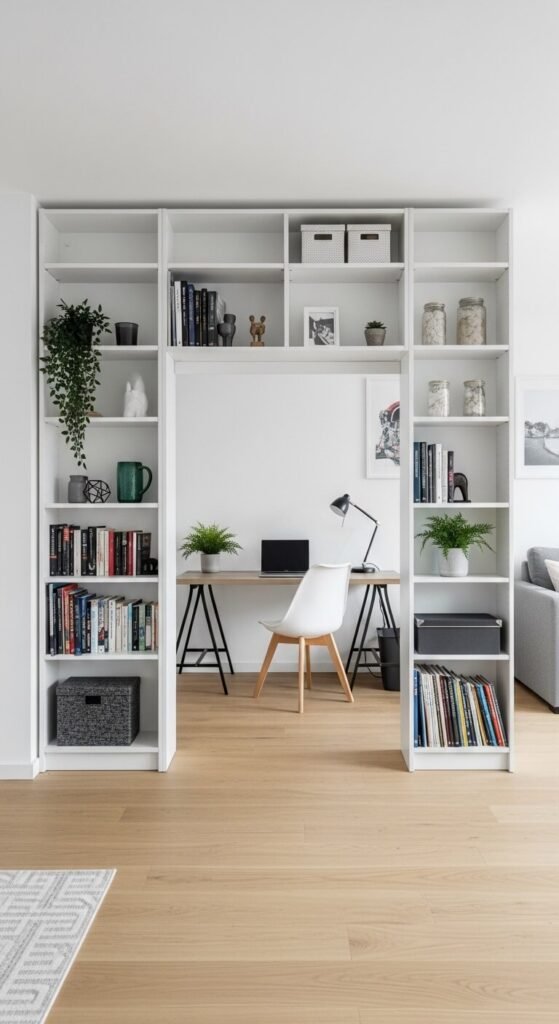
- Use a large bookcase or open shelving unit perpendicular to the wall as a partial divider; it creates separation while keeping sightlines open and adding both storage and display
Define Zones With Color and Texture on Walls and Ceilings
Paint and material changes on vertical and overhead surfaces are one of the most underused zoning techniques — and one of the most dramatic.
Color and material zone-makers:
- An accent wall in a specific zone — painting the wall behind the dining area a different color from the living area walls creates an immediate visual separation; the color change signals the zone shift
- Wallpaper in one zone only — a wallpapered dining area or living room backdrop within an open plan instantly distinguishes that zone as its own defined space
- A ceiling treatment over one zone — paint the ceiling above the dining table a contrasting color, add exposed beams over the living zone, or install a coffered ceiling in one area; overhead differentiation is remarkably effective at zone definition
- Different flooring materials — if you’re renovating, transitioning from hardwood to tile or from one wood tone to another is one of the cleanest and most permanent zone boundaries possible
Even a single painted wall in a different hue communicates zone change powerfully.
Add Partial Dividers That Preserve the View
When you want more structure than furniture arrangement alone provides but less permanence than an actual wall, partial dividers are the perfect middle ground. They create a physical boundary without closing the space off entirely.
Partial dividers worth considering:
- A bookcase or open shelving unit positioned perpendicular to the wall — open on both sides for light and sightlines, but substantial enough to register as a divider
- A curtain on a ceiling track — hung from a track mounted to the ceiling, a linen or sheer curtain can be opened completely for an open feel or drawn partially to define a zone; ideal for home offices within open plans
- A row of tall plants — four or five large plants in a line creates a soft, organic partition that breathes and lives; fiddle leaf figs, tall snake plants, or olive trees all work beautifully
- A folding screen or room divider — lightweight, movable, and available in every aesthetic from rattan to lacquered wood to woven textile; creates a zone instantly and moves when you need it to
Structure Makes Space Feel Bigger, Not Smaller
It sounds counterintuitive, but a well-zoned open plan actually feels more spacious than an unzoned one — because every area has clarity of purpose, and nothing feels wasted or uncertain. The furniture knows where it belongs. The eye knows where to look. The room knows what it is.
Save this guide for your next open-plan challenge, share it with someone who’s been struggling with a space that feels like too much of nothing, and go give every zone in your home the identity it deserves. 🏡✨