
Picture this: you fall in love with a deep teal sofa online, order it, wait six weeks for delivery, and the moment it lands in your living room you realize it clashes with your warm-toned floors, overwhelms the small space, and looks nothing like the room you imagined. The sofa is beautiful — it just doesn’t belong in your room. This is one of the most expensive and heartbreaking decorating mistakes people make, and it’s almost entirely preventable. The solution isn’t a bigger budget or better taste — it’s a mood board. Designers use them before spending a single dollar, and once you understand how to build one, you’ll never decorate without one again.
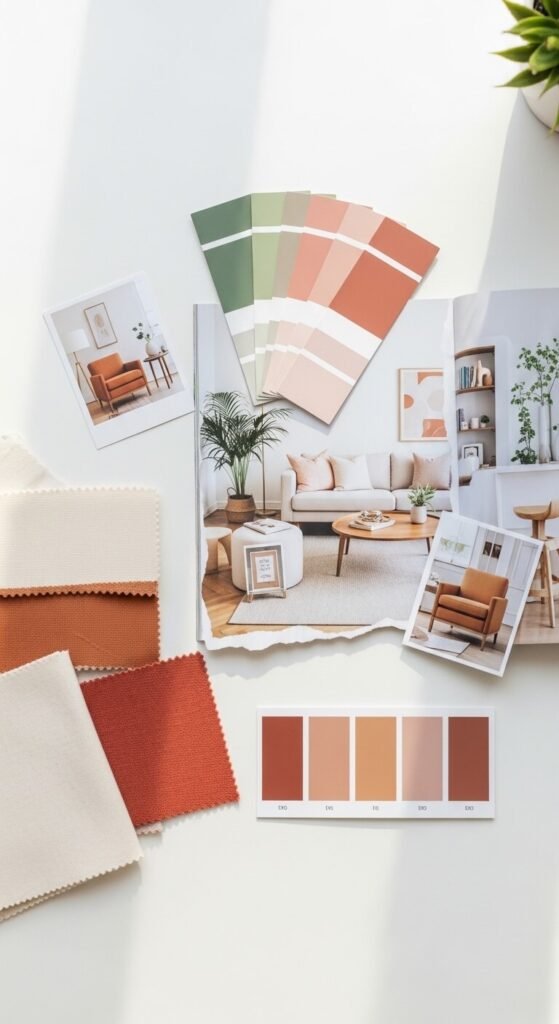
A mood board isn’t a luxury or a designer secret. It’s simply a visual plan — and it saves time, money, and the particular misery of a room that almost works but never quite does.
What a Mood Board Actually Does For You
A mood board is a curated collection of images, colors, textures, and material samples that represent the finished vision of a room before a single purchase is made. Think of it as a test run for your design decisions — a place where everything has to get along before you commit real money to any of it.
Here’s what a good mood board does:
- Reveals clashes before they become expensive mistakes — it’s much easier to see that your warm wood tones and cool grey walls fight each other on a board than after the furniture is delivered
- Creates a cohesive visual language — when every element on the board feels connected, every element in the room will too
- Gives you a shopping filter — when you’re in a store or scrolling online, you can hold every potential purchase up against the board and ask simply: does this belong here?
- Helps communicate your vision — whether you’re working with a partner, a contractor, or just trying to explain to a salesperson what you’re going for, a mood board does the talking for you
- Builds confidence — decorating decisions feel significantly less nerve-wracking when you can see how everything fits together first
Step One: Gather Your Inspiration Without Editing
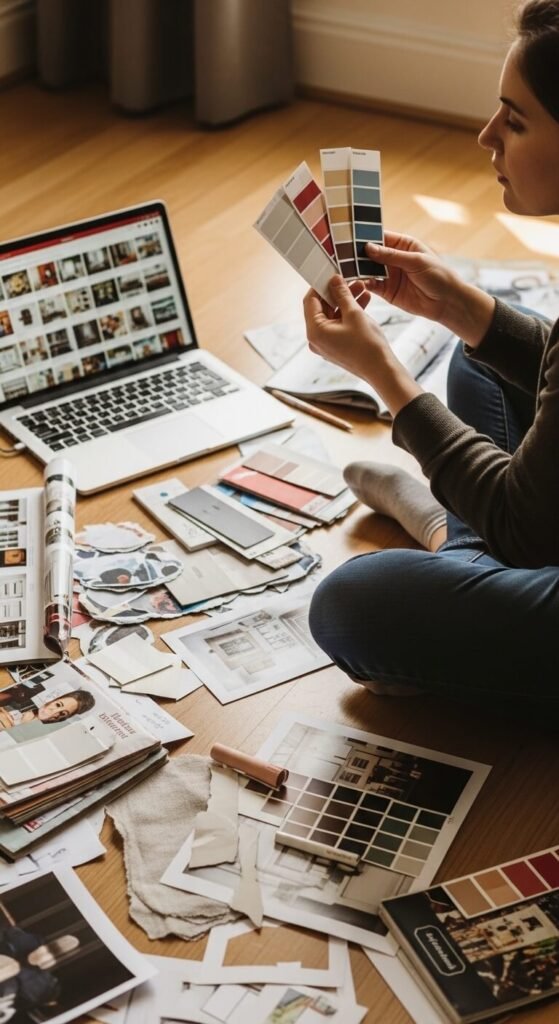
Before you can build a mood board, you need raw material to work with. This first phase is purely about collecting — no judgment, no editing, no overthinking.
Where to gather inspiration:
- Pinterest — create a dedicated board for the room you’re decorating and save everything that makes you feel something, even if you’re not sure why yet
- Instagram and interior design accounts — screenshot rooms and details that resonate with you
- Design magazines and catalogs — tear out pages and collect them physically if you prefer a tactile approach
- Your own home — photograph objects, textiles, and architectural details you already love and want to complement
- Nature walks and travel — color palettes and texture combinations that appear in the natural world are often the most beautiful and timeless sources of inspiration
Save widely and generously at this stage. You’re not committing to anything — you’re simply listening to what your eye consistently gravitates toward.
Step Two: Find the Common Thread
Once you’ve collected a bank of inspiration, step back and look at it all together. Patterns will emerge almost immediately — and those patterns are your design direction.
Ask yourself:
- What colors keep appearing? Warm neutrals, deep jewel tones, soft pastels — whatever your eye has chosen most consistently is your palette
- What textures feel most appealing? Linen and rattan? Velvet and marble? Rough plaster and smooth leather?
- What’s the mood? Calm and minimal? Rich and layered? Bright and airy? Cozy and intimate?
- What style keeps showing up? Mid-century shapes, Scandinavian simplicity, traditional symmetry, bohemian eclecticism?
You don’t need to name the style or fit into a category — you just need to identify the feeling that connects your favorite images. That feeling is your north star for every decision that follows.
Step Three: Build the Actual Board
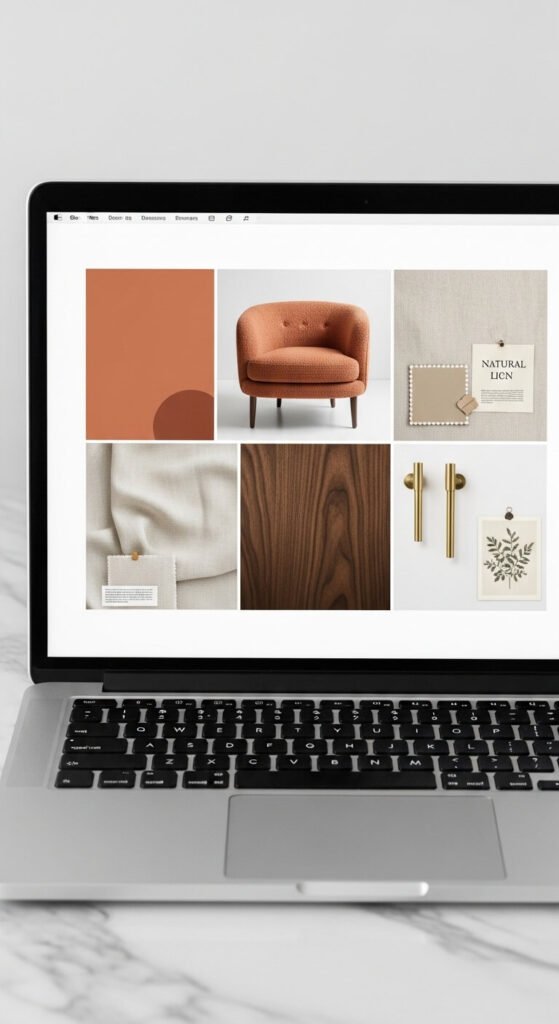
Now comes the satisfying part — assembling everything into a single, cohesive visual. You can go digital, physical, or a combination of both.
Digital mood board tools:
- Pinterest — the simplest option; create a secret board and pin everything into one place
- Canva — free and easy to use; create a custom canvas and drag in images, color blocks, and text to build a polished, shareable board
- Milanote — a more robust option for detailed boards with notes and links
- Morpholio Board — specifically designed for interior design mood boards with material and product linking
Physical mood board method:
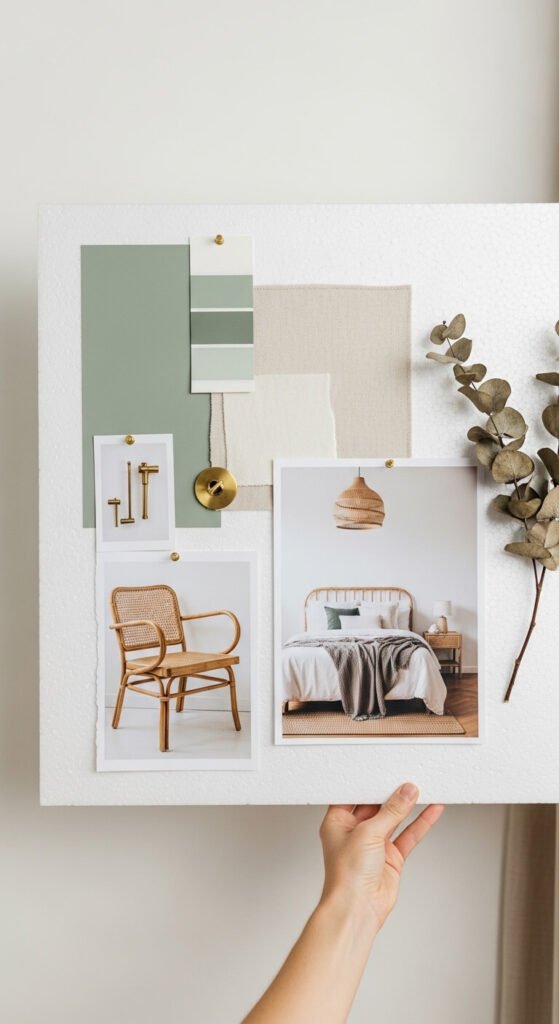
- Pin or tape swatches, images, and samples to a large piece of foam board or corkboard
- Include actual material samples wherever possible — a real paint chip, a fabric swatch, a tile sample; these are far more accurate than digital representations of color and texture
What to include on your mood board:
- Your color palette — 3 to 5 colors including your main wall color, a dominant furniture tone, an accent color, and a neutral
- Key furniture pieces — the sofa, the bed, the dining table; whatever anchors the room
- Flooring and rug samples or images
- Lighting fixtures — pendant, floor lamp, sconces
- Textile examples — cushion fabrics, throw textures, curtain materials
- Accent and decor objects — the style of vase, frame, or candleholder that fits the vision
- At least one plant or natural element — greenery ties everything together and should be planned for from the beginning
Step Four: Edit Until Everything Belongs
A mood board isn’t finished when it’s full — it’s finished when nothing on it feels out of place. This editing phase is where the real design work happens.
Questions to ask as you edit:
- Does every element share at least one quality with something else on the board — a color, a texture, a finish, a feeling?
- Is there a balance of warm and cool tones, or does everything pull in the same temperature direction?
- Are there at least three different textures represented?
- Does the overall board make you feel the way you want the room to feel?
Remove anything that doesn’t pass this test — even if you love the piece in isolation. The goal is a room that works as a whole, not a collection of individual favorites that fight each other for attention.
Plan First, Buy With Confidence
Every costly decorating mistake has something in common: a decision made in excitement before the full picture was clear. A mood board slows that impulse down just enough to let clarity catch up — and the result is a room that feels intentional, cohesive, and exactly like you imagined it.
Save this guide before your next decorating project, share it with a friend mid-renovation who’s feeling overwhelmed, and build your board before you buy a single thing. Your future room — and your future wallet — will thank you. 🎨🏡