
Here’s a truth bomb: the wrong rug size can make even a spacious room feel cramped and awkward. And unfortunately, most people choose rugs that are way too small for their space, creating that “furniture floating on an island” look that actually makes rooms appear smaller.
It sounds counterintuitive—wouldn’t a smaller rug leave more floor space visible and make the room feel larger? Nope. The opposite is true. A properly sized rug creates visual continuity, grounds your furniture, and tricks the eye into perceiving more square footage than actually exists.
The difference between a rug that shrinks your room and one that expands it often comes down to just 1-2 feet in either direction. Once you understand the sizing principles that designers use, you’ll never make the “too small rug” mistake again. Your rooms are about to feel significantly more spacious—without knocking down a single wall.
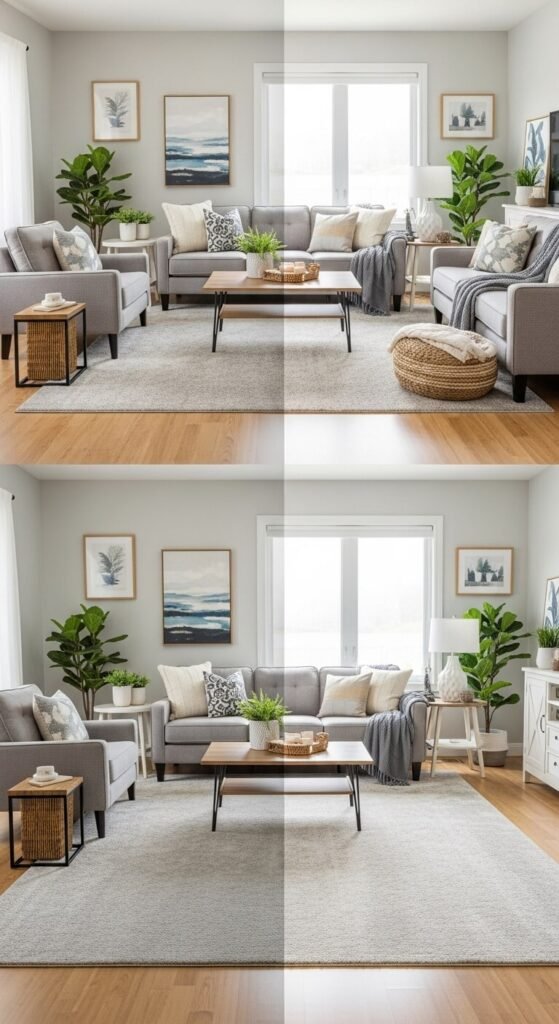
Understand The Golden Rule (Bigger Is Almost Always Better)
Let’s start with the fundamental principle that changes everything: when in doubt, size up, never down.
Why larger rugs create spaciousness:
- They unify furniture groupings into one cohesive zone
- They create horizontal lines that stretch across the room
- They minimize visual breaks in the floor plane
- They make the room read as one large space instead of fragmented areas
- They anchor furniture and prevent the “floating” effect
The most common rug mistake is buying an 5×7 or 6×9 when you actually need an 8×10 or 9×12. Those extra feet make all the difference between a room that feels pulled together versus one that feels choppy and small.
Think of your rug as the foundation of your room. A solid, substantial foundation makes everything built upon it feel more grounded and expansive.
Follow The “All Furniture On” Rule For Living Rooms
This is the gold standard for rug sizing in living rooms, and it’s the single most effective way to make the space feel larger.
The complete guideline:
Ideal scenario: All furniture legs rest completely on the rug
- Sofa: all four legs on the rug
- Chairs: all legs on the rug
- Coffee table: completely on the rug
- Side tables: can be on or off
This creates one unified seating area that reads as a single, large zone rather than individual pieces scattered around the room.
Minimum acceptable: Front legs of all seating on the rug
- Back legs of sofa and chairs can be off the rug
- Coffee table fully on the rug
- Creates a pulled-together look even in smaller spaces
Avoid at all costs: Only the coffee table on the rug with all furniture off
- This is the #1 mistake that makes rooms look smaller
- Creates a disconnected, floating effect
- Visually chops the room into fragments
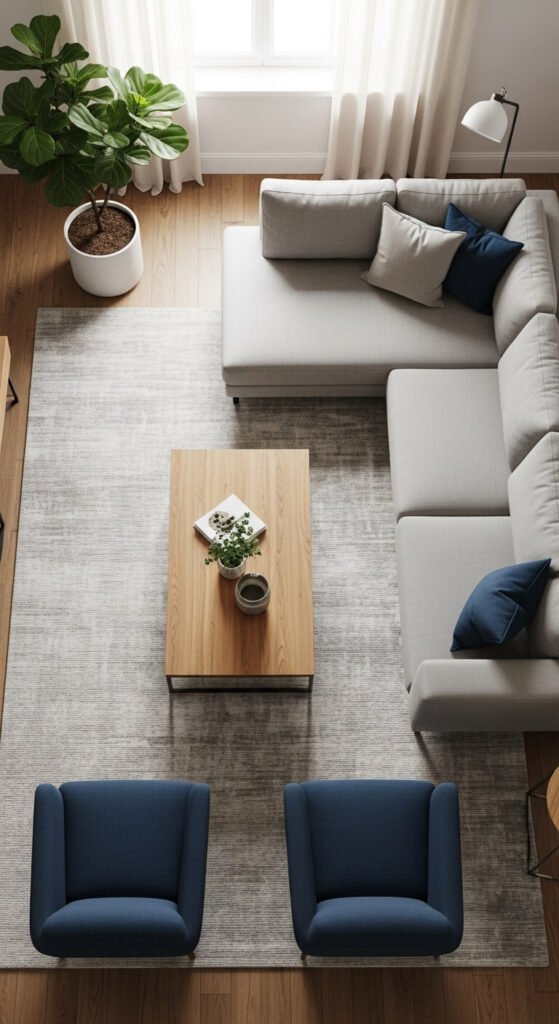
Use The 18-24 Inch Border Rule
Here’s the specific measurement that professionals use: leave 18-24 inches of exposed floor between your rug edges and the walls on all sides.
Why this border matters:
- Creates a visual frame around your rug and furniture
- Makes the room feel intentionally designed
- Prevents the “wall-to-wall carpet” look
- Allows your flooring to show, which adds depth
- Makes the rug feel like it fits the space perfectly
Measuring for the border:
- Measure your room dimensions
- Subtract 36-48 inches from both length and width (18-24 inches per side × 2)
- That’s your ideal rug size
Example:
- Room: 12 feet × 15 feet
- Subtract: 4 feet from width (12-4=8), 4 feet from length (15-4=11)
- Ideal rug: 8×11 or closest standard size (8×10 or 9×12)
This border creates breathing room that paradoxically makes the space feel larger, not smaller. It’s one of those visual tricks that seems backward but absolutely works.
Choose The Right Size For Different Room Types
Each room type has specific sizing needs. Applying the correct formula for each space ensures maximum visual expansion.
Living room sizes:
- Small (10×12 ft): 5×8 or 6×9 rug (front legs on)
- Medium (12×15 ft): 8×10 or 9×12 rug (all legs on)
- Large (15×18 ft): 9×12 or 10×14 rug (all legs on with room to spare)
Dining room sizes:
- Rug should extend 24-30 inches beyond table on all sides
- Chairs must remain on rug when pulled out
- Round table: round rug works best (but rectangular works too)
- For 6-person table: minimum 8×10 rug
- For 8-person table: minimum 9×12 rug
Bedroom sizes:
- Queen bed: 8×10 or 9×12 rug
- King bed: 9×12 or larger
- Rug should extend 18-24 inches beyond bed sides and foot
- Can be centered under bed or placed at foot of bed
Home office:
- Rug should extend beyond desk chair’s roll radius
- 5×7 minimum for small desks
- 8×10 for L-shaped or larger setups

Embrace Oversized Rugs In Small Rooms
This feels scary but trust the process: in small rooms, go bigger than you think you need. It’s the fastest way to make a cramped space feel more generous.
Why oversized works in small spaces:
- Creates fewer visual breaks and boundaries
- Makes the room read as one cohesive space
- Draws the eye across the full room dimension
- Eliminates the “postage stamp” effect of tiny rugs
- Grounds furniture so it doesn’t look like it’s floating
Small room strategy:
- Leave just 12-18 inches of floor showing (instead of 24)
- Sometimes you can even go with an 18-inch border on just two sides
- The rug becomes the dominant floor feature, which expands perception
Reality check: Yes, a larger rug costs more. But it’s worth saving for the right size rather than buying a too-small rug that makes your room look worse. Consider it an investment in making your space look and feel significantly larger.
Consider Rug Shape For Spatial Perception
Shape affects how expansive a room feels. The right shape enhances your room’s natural proportions and maximizes the sense of space.
Shape psychology:
Rectangular rugs:
- Emphasize length and width
- Make rooms feel longer or wider depending on orientation
- Best for most living rooms and bedrooms
- Most versatile option
Square rugs:
- Emphasize symmetry and balance
- Work well in square rooms
- Create intimate conversation areas
- Can make long, narrow rooms feel more balanced
Round rugs:
- Soften angular rooms
- Create focal points
- Work beautifully under round dining tables
- Can make small spaces feel more open by eliminating corners
Runners:
- Elongate hallways and narrow spaces
- Should span 2/3 to 3/4 of the hallway length
- Leave 3-6 inches from walls on each side
Pro tip: In rectangular rooms, orient your rectangular rug to emphasize the dimension you want to exaggerate. Want to make a narrow room feel wider? Place the rug’s longer dimension across the width.
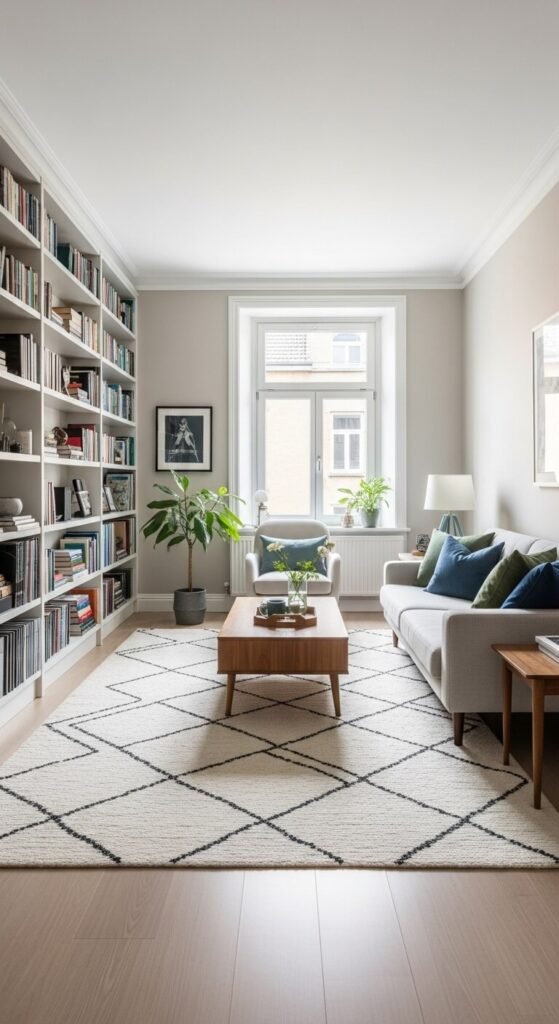
Layer Rugs To Add Dimension Without Shrinking Space
Here’s an advanced technique: layering rugs actually makes rooms feel larger by adding depth and visual interest without creating chopping effects.
Layering strategy for space expansion:
Base layer:
- Large, inexpensive neutral rug (jute, sisal, or basic neutral)
- Should follow the 18-24 inch border rule
- Covers most of the floor
Top layer:
- Smaller decorative rug with pattern or color
- Positioned strategically (under coffee table, at seating area)
- Adds personality without sacrificing the expansive base
Why this works:
- The large base rug creates the space-expanding effect
- The smaller top rug adds visual interest and style
- You get design impact without losing the spatial benefits
- More budget-friendly than one huge designer rug
This technique is especially effective in open-concept spaces where you want to define zones without making the overall space feel smaller.
Avoid These Size Mistakes That Shrink Rooms
Knowing what not to do is just as important. These common errors make even large rooms feel cramped.
Don’t do this:
❌ Tiny rug with only coffee table on it: Creates a disconnected island effect
❌ Rug that stops before furniture: Makes furniture look like it’s falling off the edge
❌ Multiple small rugs scattered around: Chops the room into fragments
❌ Rug that leaves less than 12 inches to walls: Feels cramped, not intentional
❌ Bedroom rug that only sticks out a few inches: Creates a postage stamp effect
❌ Dining rug that doesn’t accommodate pulled-out chairs: Functional failure that looks bad
❌ Different-sized rugs in connected open spaces: Creates visual confusion
When in doubt, reference back to the golden rule: bigger is better. The worst-case scenario of a too-large rug is that you have less floor showing (which usually looks fine). The worst-case scenario of a too-small rug is that your entire room looks cramped and poorly designed.
Measure Your Space Before Shopping
Don’t guess. Measuring properly saves you from expensive sizing mistakes and ensures you get the space-expanding effect you’re after.
Measurement checklist:
- Measure your room dimensions (length × width)
- Measure and map your furniture layout
- Calculate where rug edges should fall using the 18-24 inch rule
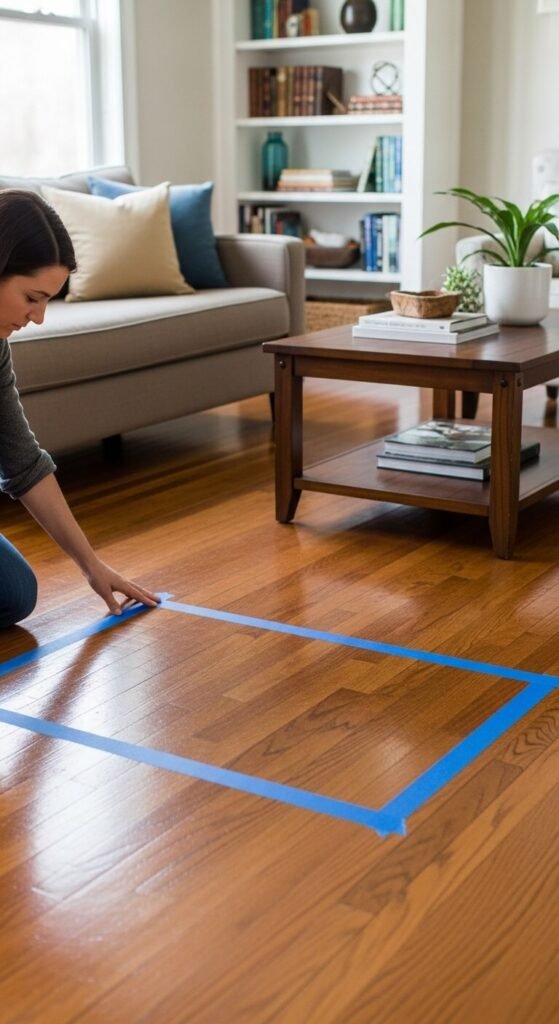
- Use painter’s tape to mark rug dimensions on your floor
- Live with the tape for a day to see if the size feels right
- Measure doorways (can the rug fit through?)
- Account for furniture legs being on/off the rug
The painter’s tape trick is crucial—it lets you visualize the actual rug size before committing. You can adjust the tape boundaries until it feels perfect, then shop with confidence knowing exactly what size you need.
Pro tip: When shopping online, check if retailers offer size visualization tools or AR apps that show how rugs will look in your space. These can be incredibly helpful for confirming your measurements.
Ready to make your room feel instantly more spacious? Start by measuring your space properly, then size up from whatever rug size you were originally considering. Remember: all furniture legs on the rug, 18-24 inch borders from walls, and when in doubt, go bigger. Your room is about to feel twice as large without changing a single thing except your rug size. Save this guide before your next rug shopping trip—your spatially-challenged rooms will thank you! 📐✨