
The gap between a bunch of flowers that looks like it came straight from the supermarket and one that looks like it came from a florist is almost never about the flowers themselves. It is about three things: how the stems are cut, how the flowers are grouped before arranging, and how the arrangement builds from structure outward. Professional florists do not have better flowers — they have a method. And that method, once understood, produces genuinely beautiful arrangements from the same grocery store bunches that most people plunge straight into a vase and feel faintly disappointed by. This guide teaches you that method, step by step, so that every bunch of flowers you bring home becomes the arrangement it was always capable of being.
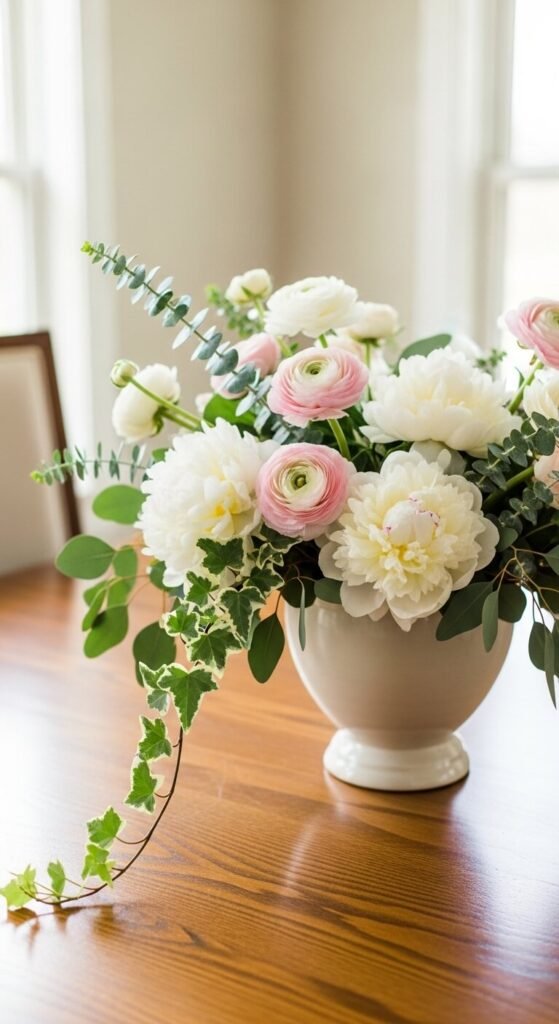
Here is the complete method — from preparing stems to finishing touches.
Prepare the Stems Before You Begin
The single most important step in flower arranging happens before a single stem enters the vase — and most people skip it entirely.
What to do:
- Fill a clean bucket or sink with cool water
- Remove all foliage that will sit below the waterline in the vase — submerged leaves rot within days and contaminate the water, which shortens every flower’s life significantly
- Cut all stems at a 45-degree angle under cool running water or while submerged — a diagonal cut increases the stem’s surface area for water uptake dramatically. Use sharp scissors or a floral knife, not household scissors with dull blades.
- Place all prepared stems back in the water for at least 30 minutes before arranging — this conditioning period allows the stems to hydrate fully and produces an arrangement that lasts days longer than one made with freshly cut but unconditioned stems
The 45-degree cut matters more than most people realize. A straight cut places the stem flat against the vase base, blocking water uptake. The diagonal cut keeps the opening elevated and constantly in contact with water.
Build in Three Layers: Foliage First
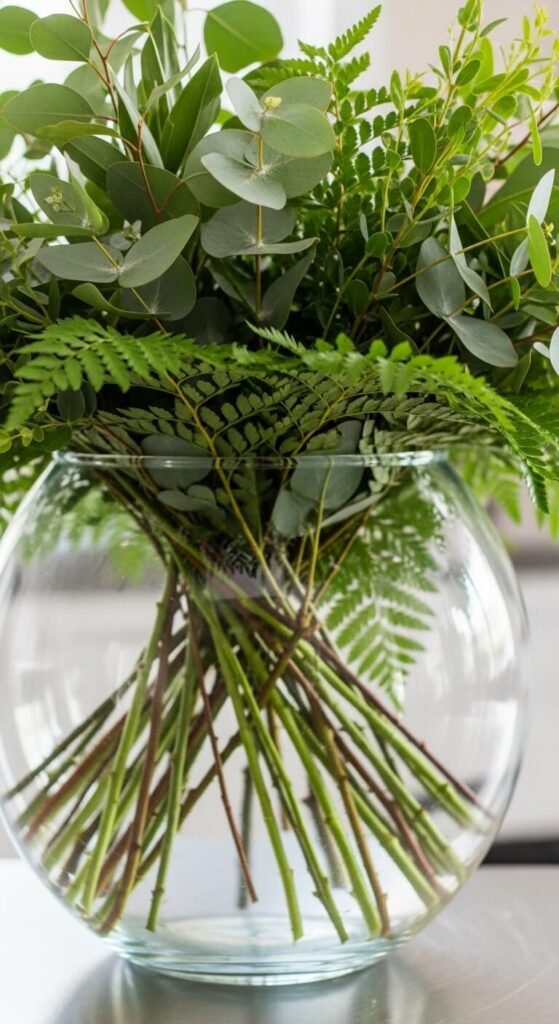
Professional florists always build arrangements in three layers, and understanding this changes everything about how the finished arrangement looks.
Layer one — foliage: Start with greenery. Eucalyptus, fern, ruscus, ivy, or any available foliage. Place stems throughout the vase at different heights and angles until the foliage forms a full, slightly domed shape with stems crossing inside the vase. These crossing stems create a natural grid that holds every subsequent flower in position without any floral foam or mechanics.
Layer two — focal flowers: These are the largest, most dramatic blooms — peonies, roses, sunflowers, garden roses, ranunculus. Place them at different heights, not all at the same level. Avoid placing two flowers of the same type directly beside each other — distribute each type throughout the arrangement.
Layer three — filler and accent flowers: Smaller blooms like waxflower, statice, sweet pea, or spray roses fill the gaps between focal flowers and add color variation at smaller scales. These go in last and their placement is determined by what the arrangement shows as missing.
The Height Variation Rule
This is the rule that most clearly distinguishes a florist arrangement from a home arrangement.
In most home arrangements: all stems are the same height. The flowers sit in a flat layer across the top of the vase. The result looks like the bunch was transferred from the wrapper directly into water.
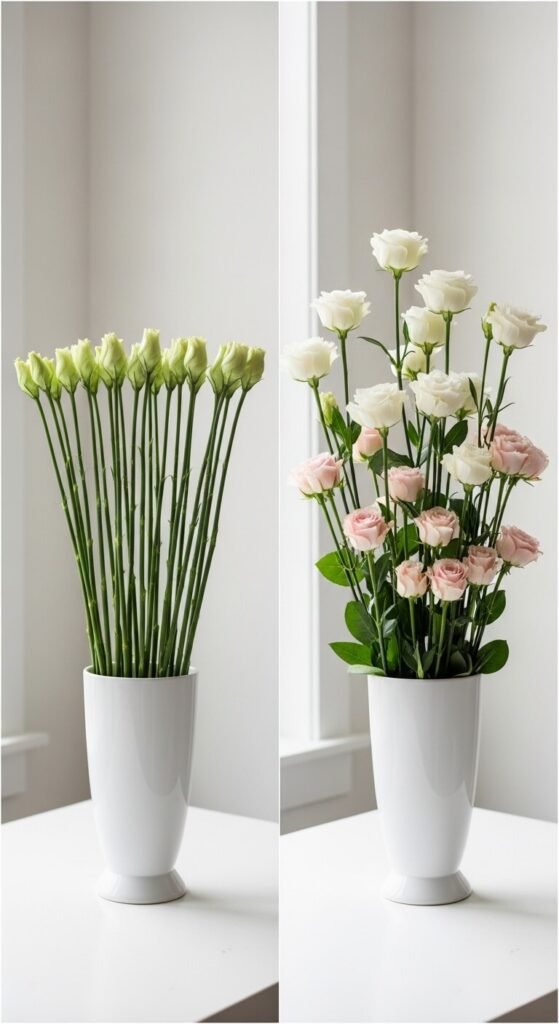
In a florist arrangement: stems are cut at three to five different heights. The tallest stem is approximately 1.5 to 2 times the height of the vase. The shortest sits just above the vase rim. Everything else falls between those two extremes.
How to achieve this:
- Cut your first stem at the desired tallest height — this sets the arrangement’s scale
- Cut subsequent stems progressively shorter, varying between the tallest and shortest
- Step back and view the arrangement from the front every few stems — adjust height by pulling stems up or pushing them deeper into the vase
Odd Numbers and the Spiral Technique
Two professional techniques that consistently improve the look of any home arrangement:
Odd numbers: Always use an odd number of each flower type — three roses, five stems of eucalyptus, seven ranunculus. Odd-numbered groupings look naturally balanced where even-numbered groupings look rigid and symmetrical in a way that reads as arranged rather than grown.
The spiral technique: As you add each stem to the vase, hold the arrangement in one hand and rotate it slightly — adding each new stem at a slight diagonal in the same rotational direction. This naturally creates a spiral of stems inside the vase that fans outward in every direction. The result is an arrangement that looks equally good from all angles rather than having a clear front and an empty back.
The Finishing Touches That Elevate Every Arrangement
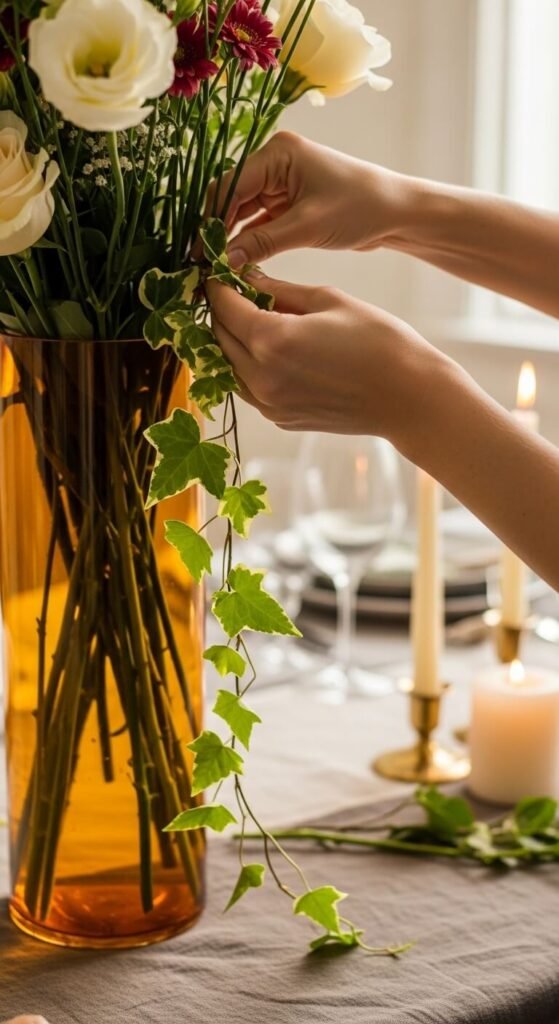
Once the three layers are complete:
- Add trailing elements — a few ivy tendrils, a long stem of jasmine, or a trailing eucalyptus branch tucked at the front to cascade down the vase face. Movement at the base of the arrangement adds elegance that upright arrangements lack.
- Step back and rotate — view from all sides and adjust any stem that appears isolated or at an angle that conflicts with its neighbors
- Top up the water — the arrangement has absorbed water during building. Fill to within an inch of the rim before placing.
- Change the water every two days and re-cut stems at the same time — this single maintenance habit doubles the lifespan of most arrangements
Every Grocery Store Bunch Deserves This
The flowers available at a supermarket are genuinely beautiful. They are grown by people who care about them, transported carefully, and sold at a price that makes fresh flowers accessible to every household every week. What they need — what every flower needs — is someone who knows how to let them be what they are capable of being.
That is all florist arranging is. Structure, preparation, and enough patience to build the arrangement one layer at a time.
Save this and pin it as your forever flower arranging guide — because once you arrange flowers this way, a simple grocery store bunch will never look plain again.