
A gallery wall is the most personal design decision you can make in a home. Unlike a sofa or a rug, it does not come from a catalog — it comes from you. The photographs, artworks, prints, objects, and mirrors you choose to hang together on a single wall create a visual autobiography that tells visitors something real about how you see the world, what you have experienced, and what genuinely matters to you. The challenge is not finding the objects — most people already own them. The challenge is understanding how to arrange them so the wall feels intentional rather than improvised. These 28 gallery wall layouts cover every room size, wall shape, aesthetic preference, and budget, giving you the practical knowledge to plan, arrange, and hang a wall display that becomes the defining feature of any room it occupies.
1. The Classic Eclectic Mix with Unified Frame Finish
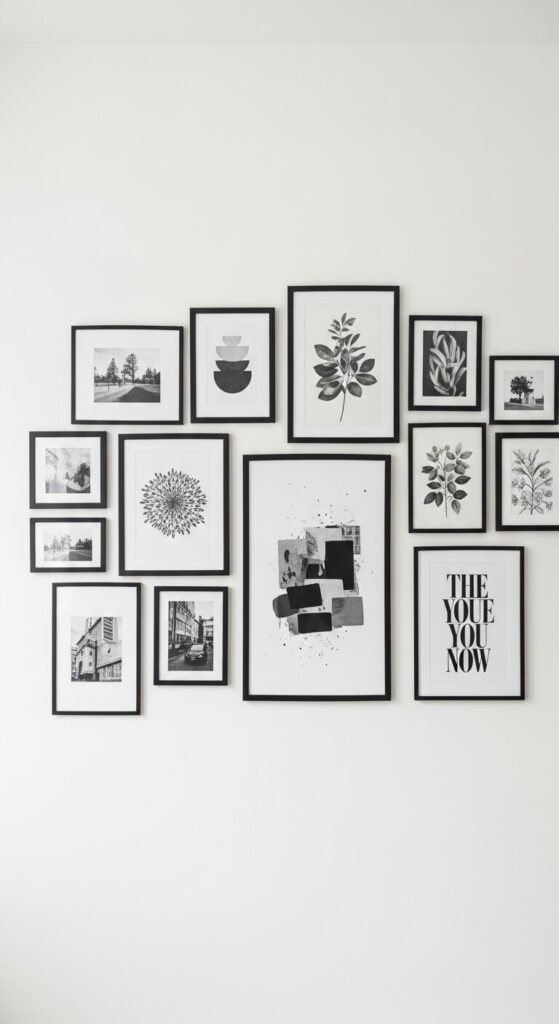
The most forgiving gallery wall layout uses a completely mixed collection of artwork and photographs unified by a single frame finish. Choose one frame color — all black, all white, or all natural wood — and apply it to every single piece regardless of size or content. The unified frame finish is the thread that holds an otherwise diverse collection together. Buy inexpensive frames from discount stores and spray paint them all in the same matte finish — one $4 can covers ten to twelve frames. Lay the arrangement on the floor before hanging. Start with the largest piece, center it at eye level, then build outward from there.
2. Grid Layout with Identical Frames and Prints
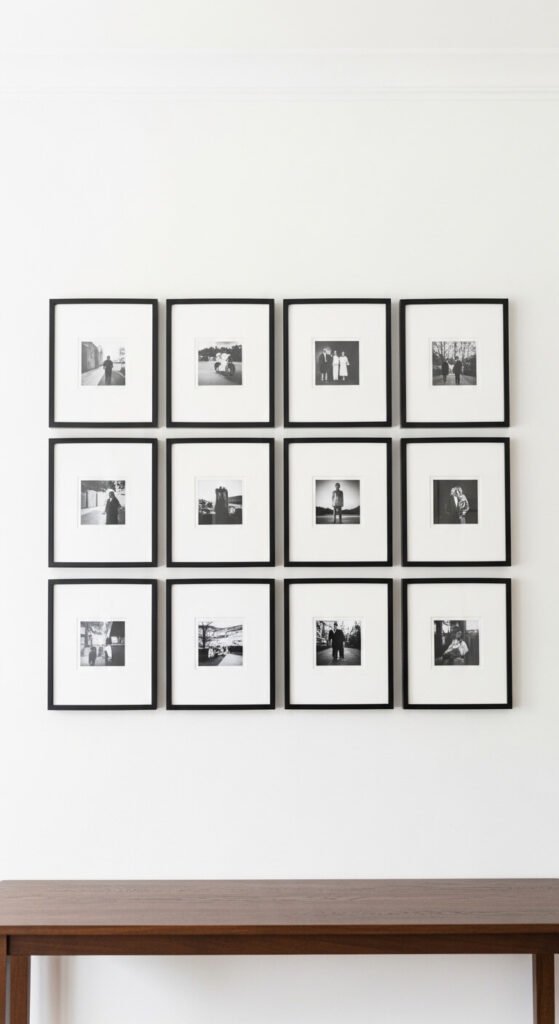
A grid of identical frames with matching prints is the most formal and graphic gallery wall layout. Use the same frame size, same frame finish, and same print style throughout — all black-and-white photographs, all botanical prints, or all abstract color studies in the same palette. Space frames exactly 2 inches apart throughout the grid using a level and measuring tape. This layout suits modern, Scandinavian, and minimalist interiors particularly well. Print a set of personal photographs in black-and-white at a copy shop for $1 to $3 each. A 3×4 grid of 8×10 frames costs around $40 to $60 in total materials and looks genuinely gallery-quality when hung with precision.
3. Salon-Style Floor-to-Ceiling Arrangement
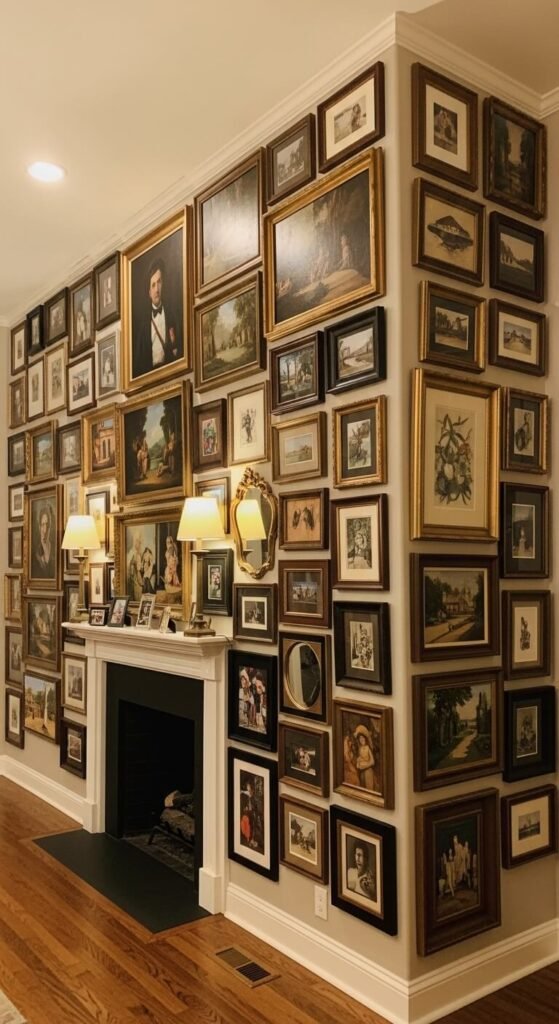
The salon-style gallery wall covers the entire wall from floor to ceiling in a dense, layered arrangement that references the great European picture salons of the 18th and 19th centuries. Start by covering the center of the wall at eye level and work outward and upward in all directions, maintaining 1 to 2-inch spacing throughout. Mix painting styles, frame finishes, and subject matter freely — the density and scale of the arrangement create the cohesion. This layout works best on a large feature wall in a living room or hallway. Collect pieces over time from thrift stores, flea markets, and estate sales. No single piece needs to be expensive.
4. Black and White Photography Staircase Wall
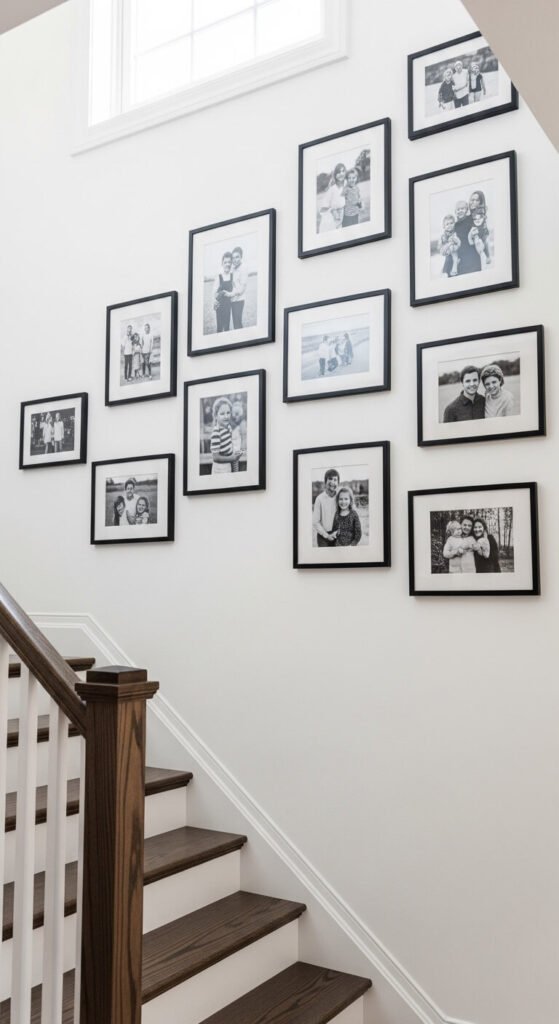
A staircase wall ascending gallery of black-and-white family photographs is one of the most emotionally resonant gallery walls you can create. Follow the diagonal line of the staircase, arranging frames so their centers align with an invisible line running parallel to the stair angle. Use the same frame finish throughout — all black or all white — so the varied photographic subjects remain the focus. Print a collection of personal photographs in black-and-white at a local print shop for $1 to $3 each. A staircase gallery of 15 to 20 photographs costs under $60 in total frames and prints from discount frame shops.
5. Large Anchor Piece with Smaller Surrounding Frames
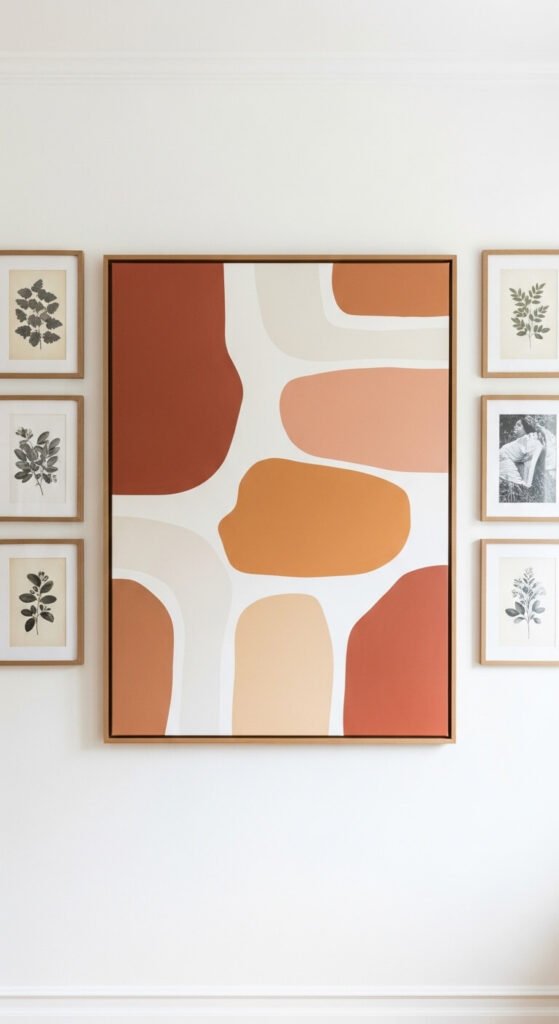
Building a gallery wall around one large anchor piece creates an immediate visual hierarchy that organizes the entire wall arrangement. The anchor piece should be at least twice the size of any other frame on the wall — 30×40 or larger works best as a true anchor. Hang it first at exact eye level, then arrange smaller frames around it in a loose border formation. The smaller frames should support the anchor rather than compete with it — keep them in complementary tones and simpler content. One large canvas print from an online print service costs $30 to $60. The surrounding smaller frames can be sourced from thrift stores for $2 to $8 each.
6. Botanical Print Collection in Matching Mounts
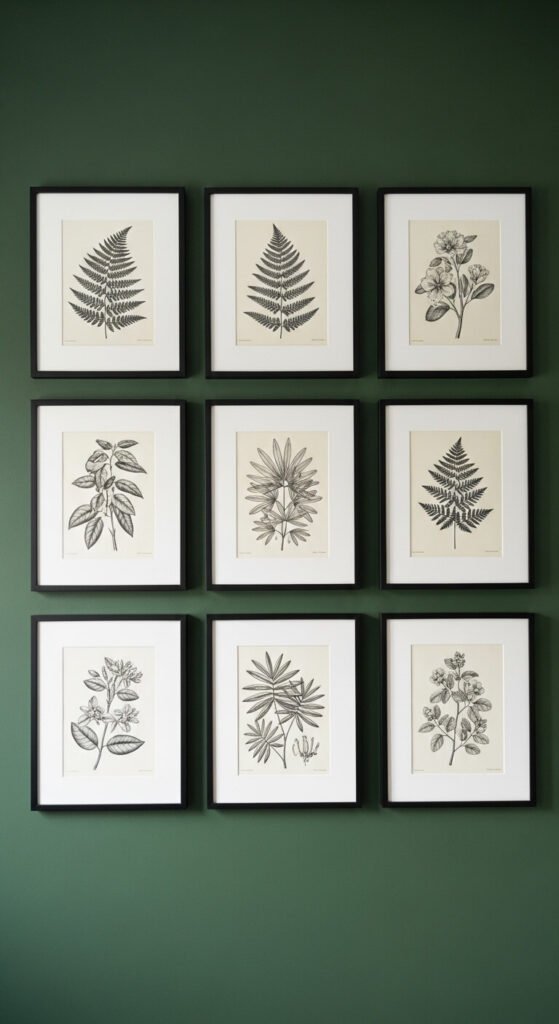
A dedicated botanical print collection hung as a grid creates one of the most consistently well-received gallery wall styles in any interior. Download free antique botanical illustrations from public domain archives — the Biodiversity Heritage Library and Rawpixel both offer thousands of high-quality historical botanical engravings free to download. Print on cream cardstock at a local copy shop for $2 to $4 per print. Mount in identical frames with wide white mats. A 3×3 grid of 12×16 framed botanical prints on a dark-painted wall costs under $50 total. The dark wall makes the cream prints read as dramatically more expensive than they actually are.
7. Mixed Media Wall with 3D Objects Alongside Frames
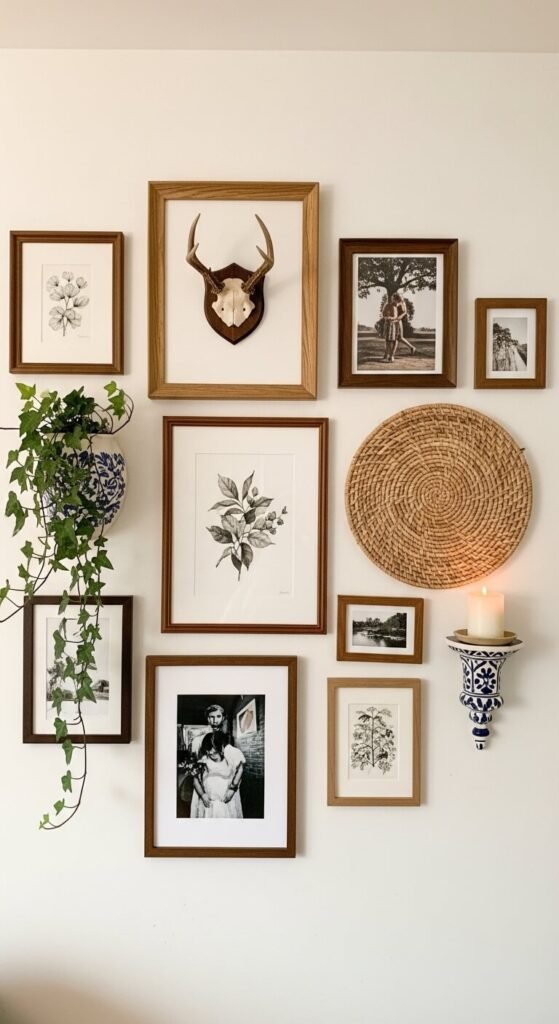
A gallery wall becomes more interesting when it includes three-dimensional objects alongside flat framed pieces. Hang woven wall hangings, small ceramic wall planters, decorative mirrors, mounted antlers, a small wall-mount shelf, or a sculptural wall object alongside frames. The dimensional objects create shadows and depth that flat prints cannot. Mix them at irregular intervals throughout the arrangement so they feel discovered rather than placed. Woven wall hangings from independent makers cost $15 to $40. Small ceramic wall planters cost $8 to $20. Incorporate these alongside your printed and photographic pieces to give the wall a genuinely three-dimensional quality that photographs and visitors both respond to.
8. Symmetrical Two-Panel Arrangement
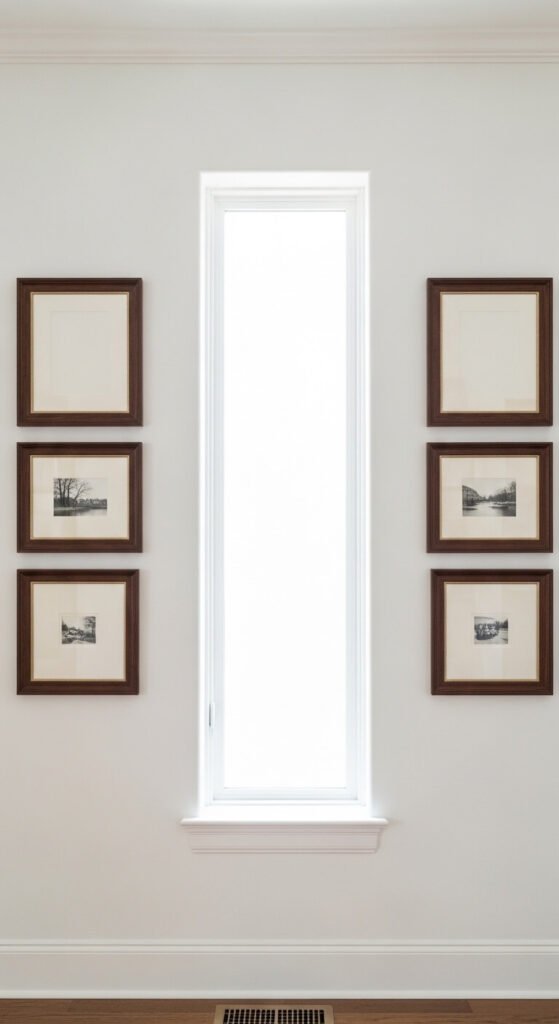
A symmetrical two-panel arrangement on either side of a window, door, or fireplace creates a formal, architectural gallery wall that suits traditional and transitional interiors particularly well. Treat each side as a mirror image of the other — same frame sizes, same positions, same content type. Use a central architectural feature like a window or fireplace as the axis. The symmetry does the compositional work — individual pieces within each panel do not need to be particularly striking because the overall arrangement carries the visual weight. This is one of the most approachable gallery wall layouts for people who find asymmetric arrangements difficult to plan confidently.
9. Travel Photography Wall in a Hallway
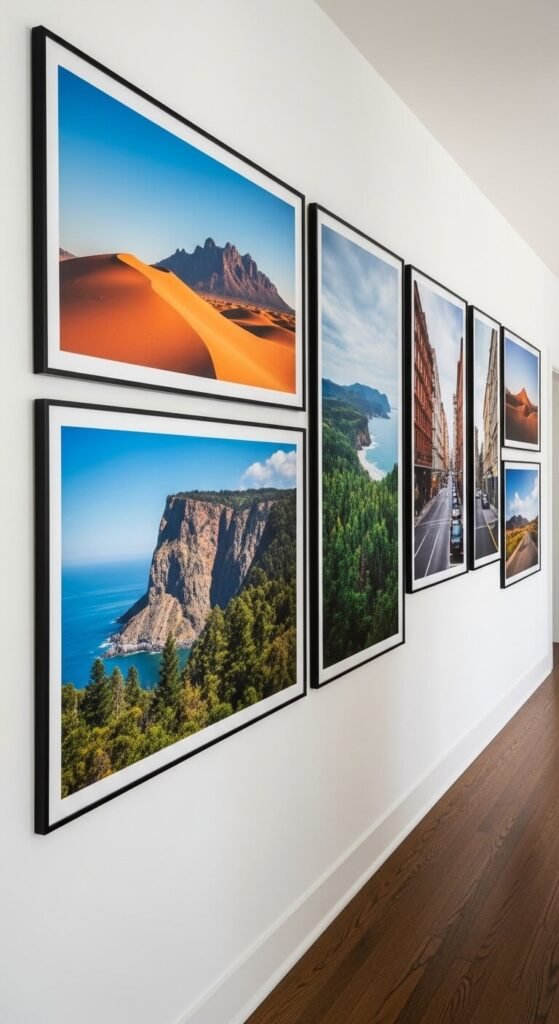
A hallway is ideal for a travel photography gallery because the long linear space suits a single horizontal row of images seen in sequence as you walk through. Mount large-format landscape photographs at consistent eye level in a single horizontal line, spacing them evenly at 3 to 4 inches apart. The consistency of the line is the organizing principle — content and color within each image can vary freely. Print your own travel photographs in large format at an online print service — a 12×18 print costs $5 to $10. Simple thin black frames from a discount store cost $8 to $15 each. A hallway of ten travel photographs costs around $100 to $150 total.
10. Children’s Artwork Rotating Gallery
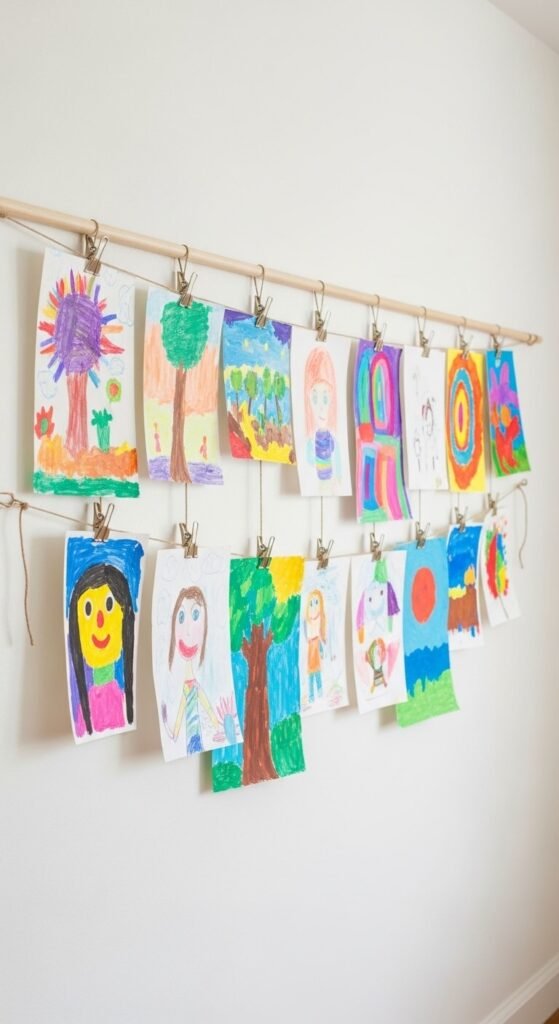
A clip-rail gallery system for children’s artwork solves both a storage problem and a display opportunity simultaneously. Mount a wooden picture rail or a length of wooden dowel at child eye level and use small binder clips or wooden pegs to hang artwork without any frames or holes in the wall. The clip system lets you rotate pieces in and out as new artwork arrives without any rehang process. A wooden dowel from a hardware store costs $3 to $5. Twelve binder clips cost $1. String or twine for hanging costs $2. The whole system costs under $10 and makes children feel genuinely proud that their work is displayed rather than stored in a drawer.
11. Vintage Map Collection Gallery Wall
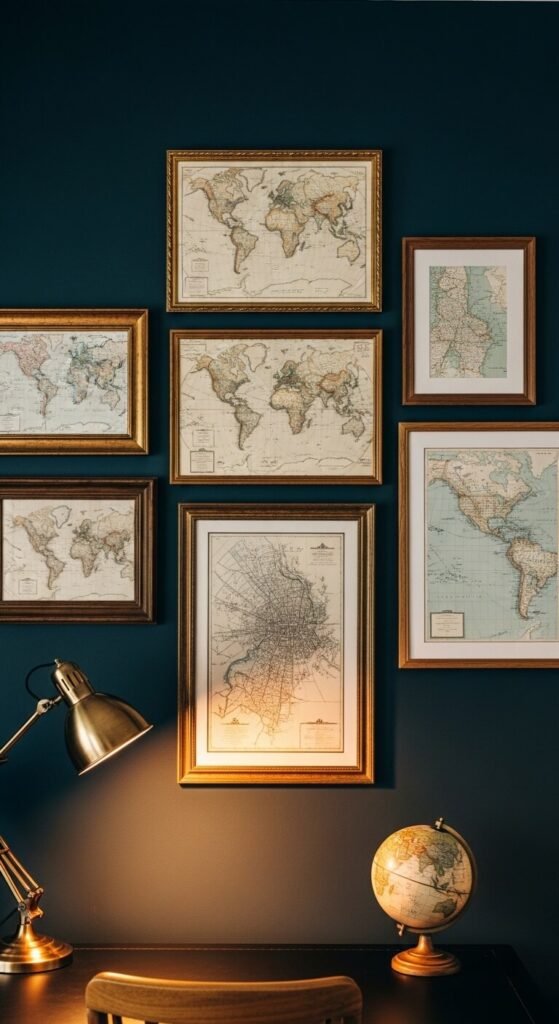
A curated collection of vintage or antique-style maps creates a gallery wall with strong intellectual character and visual texture. Use maps of places that are personally meaningful — where you grew up, where you traveled, where you met your partner — rather than generic decorative maps. Download high-resolution vintage maps free from the David Rumsey Map Collection online and print them at a copy shop for $3 to $8 per map. Frame in a mix of ornate gold and simple dark wood frames for a collected, over-time quality. A dark navy or forest green painted wall behind the maps makes the sepia and cream tones read dramatically richer.
12. Black Frame Wall Over a Sofa
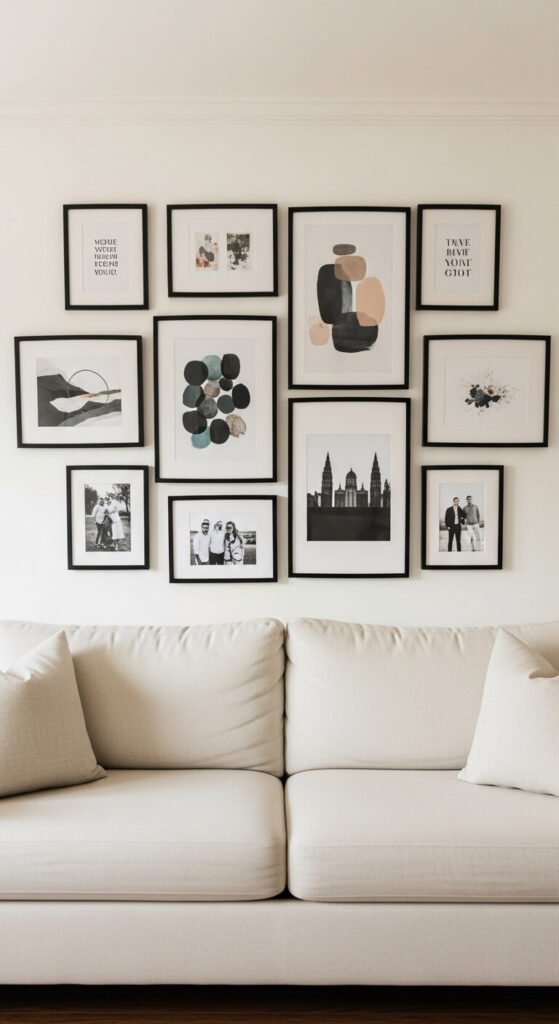
The wall above a sofa is the most common gallery wall location — and the most impactful when done well. The arrangement should span approximately the same width as the sofa and extend 8 to 10 inches above the sofa back at its lowest point. A too-narrow arrangement on a wide sofa looks unbalanced. Keep the lowest row 8 inches above the sofa back to avoid hitting heads. Use all the same frame finish to unify diverse content. A sofa gallery wall of 10 to 12 frames costs $40 to $80 in total using discount frames and printed artwork. This is the arrangement most likely to define the character of an entire living room.
13. Watercolor Art Collection in Oval and Round Frames
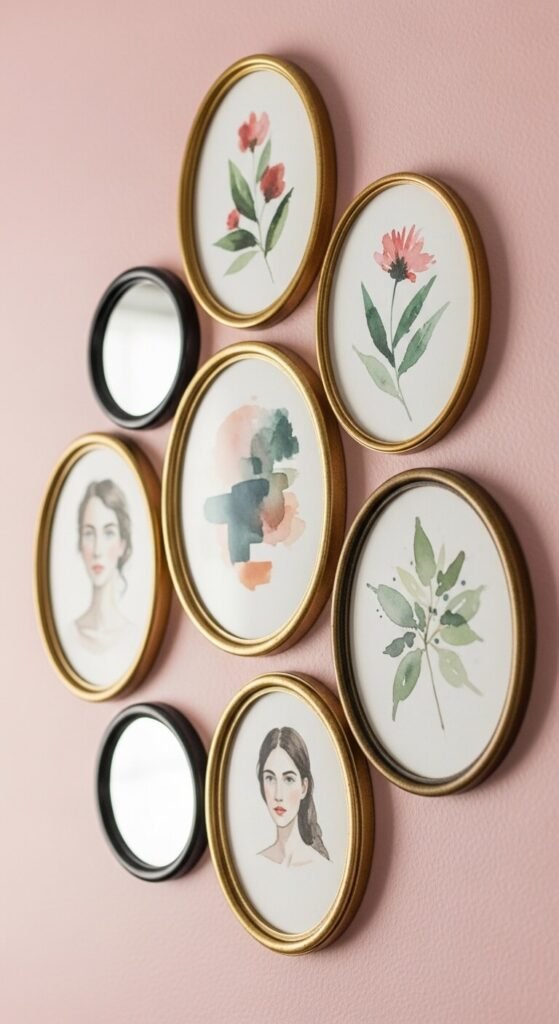
A gallery wall built around oval and round frames rather than the standard rectangular format creates an unexpected, romantic quality that suits bedrooms, dressing rooms, and powder rooms particularly well. Mix oval gilded frames, small circular frames, and one or two round mirrors in a tight organic cluster rather than a formal grid. The curved edges of the frames relate naturally to each other and create flowing eye movement through the arrangement. Oval frames from thrift stores and antique shops cost $3 to $15 each. Fill them with your own watercolor paintings, downloaded floral prints, or personal photographs printed in soft tones.
14. Typographic Quote Wall with Consistent Typography
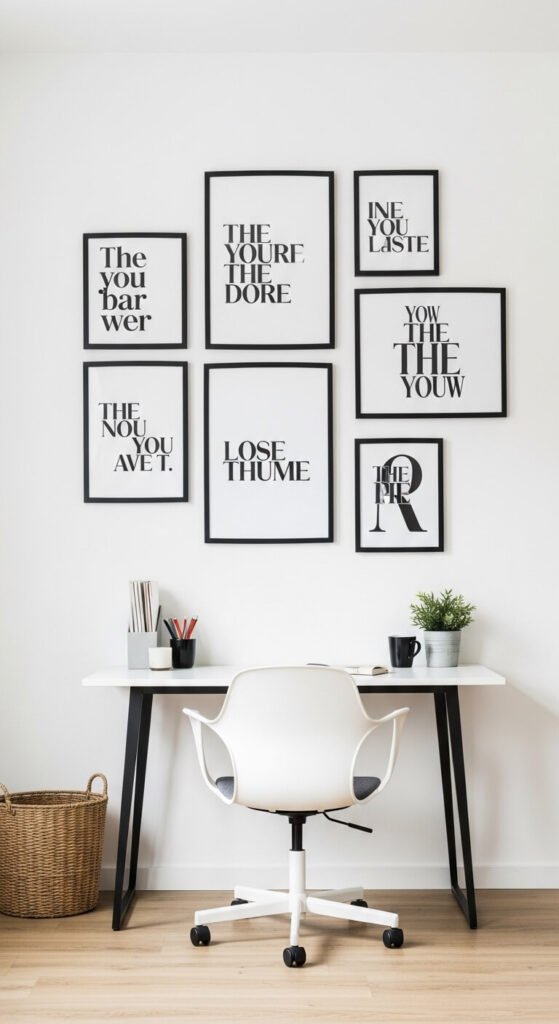
A gallery wall built entirely from typographic prints creates a wall that communicates directly through words rather than images. Keep the typography consistent — use all the same typeface across every print, varying only the size and the words. This creates a family of prints that work as a system. Design your own prints free using Canva or Google Docs and print at a copy shop for $2 to $5 each. Choose quotes, single words, or phrases that are personally meaningful rather than generic inspirational text — the personal specificity is what makes this type of wall interesting. All-black typography on white paper in black frames is the most graphic and universally suitable version.
15. Eclectic Bedroom Gallery Wall Above the Headboard
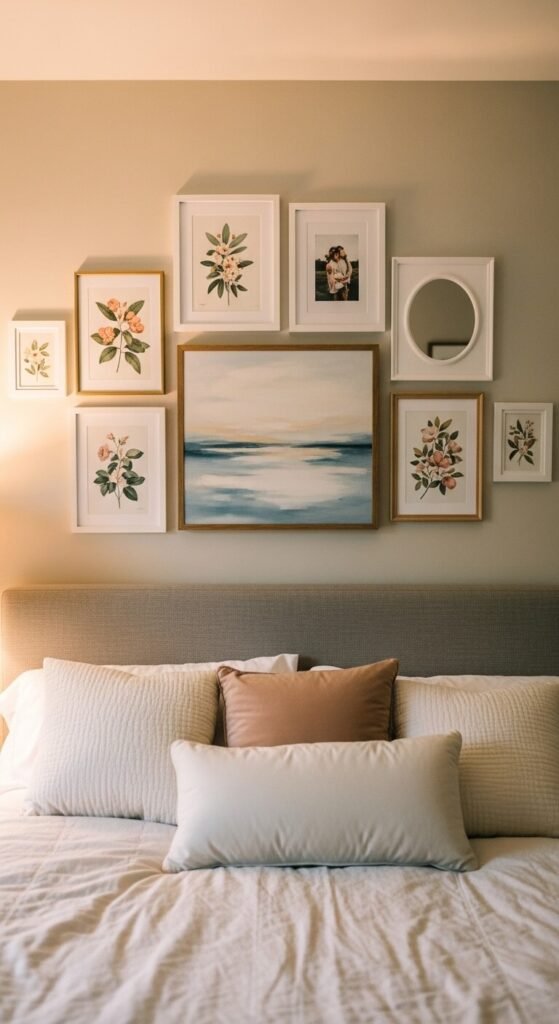
A gallery wall above a bed headboard transforms the most dominant surface in a bedroom into a personal, curated display. Center the arrangement above the headboard width and keep the lowest frame at least 8 to 10 inches above the headboard top to avoid impact with pillows. Choose content with softer tones and more intimate subject matter — botanical prints, personal photographs, abstract watercolors, and one small mirror all suit a bedroom gallery. Avoid strong graphic or typographic pieces that feel too stimulating for a sleep space. A bedroom gallery of nine frames in mixed warm finishes costs $30 to $60 using thrift store finds and printed artwork.
16. Monochrome Abstract Art Series
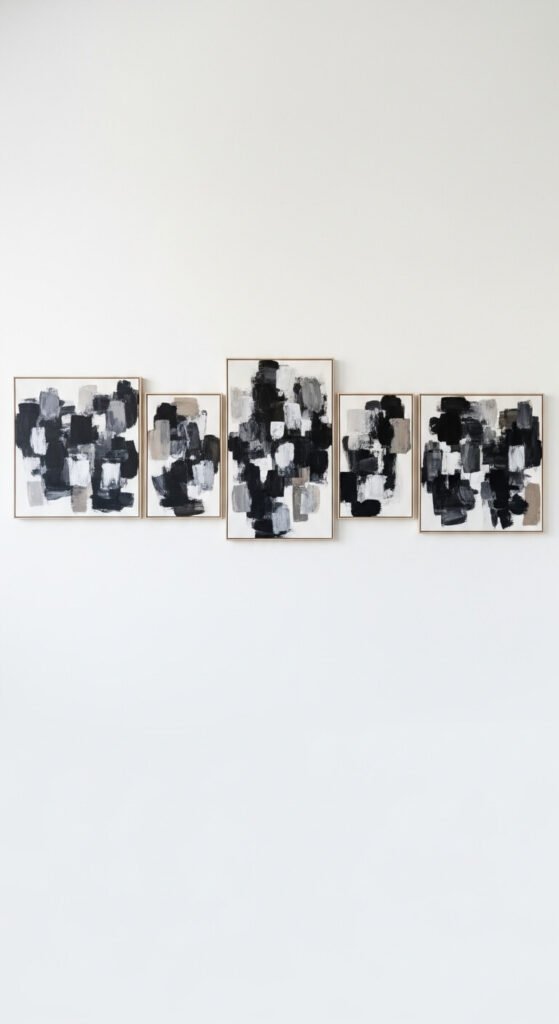
A series of abstract works in the same monochrome palette hung in a straight horizontal row creates one of the most sophisticated gallery wall layouts available. Paint five or six canvases yourself using only two or three colors in the same family — all greys, all earth tones, or all cool blues. Each canvas is a distinct abstract composition but the shared palette makes the series read as a unified body of work. Blank canvases from a craft store cost $3 to $8 each. Basic acrylic paint costs $2 to $4 per tube. A series of six hand-painted abstract canvases costs under $40 in materials and looks genuinely gallery-worthy when hung with precision.
17. Nursery Gallery Wall with Illustrated Alphabet Prints
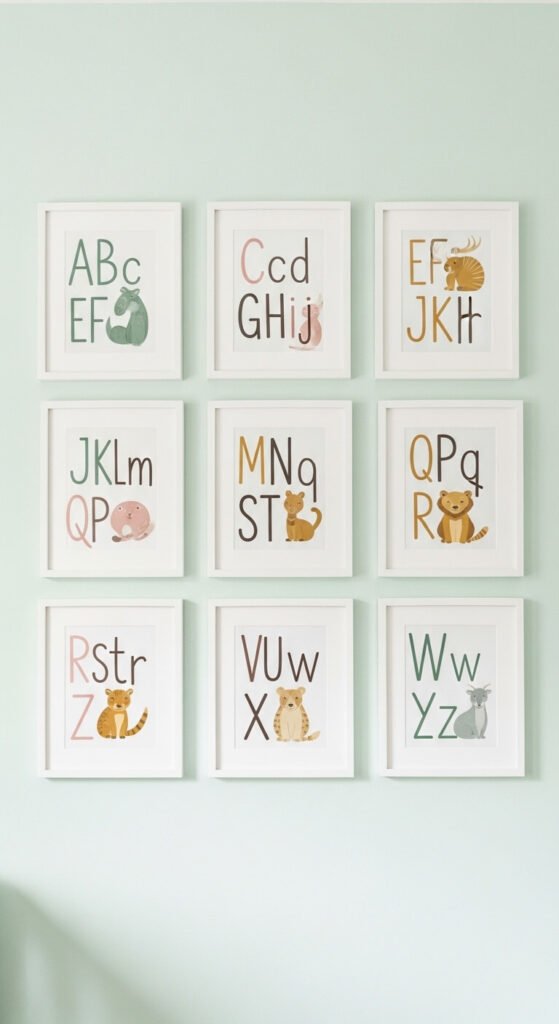
An alphabet print gallery wall in a nursery combines visual learning with decorative intention in a way that suits the space perfectly. Download or purchase a matching set of illustrated alphabet prints in a consistent illustration style and color palette. Mount all 26 in a grid — a 4×7 grid minus two spaces, or broken into multiple smaller groupings. Matching white frames from a discount store cost $3 to $6 each for a 5×7 size. A full alphabet set of prints from Etsy costs $15 to $30 as a digital download that you print yourself. The uniformity of the matching frames and illustration style makes a large grid of 26 pieces look ordered and intentional rather than cluttered.
18. Vintage Poster Collection from Personal Passions
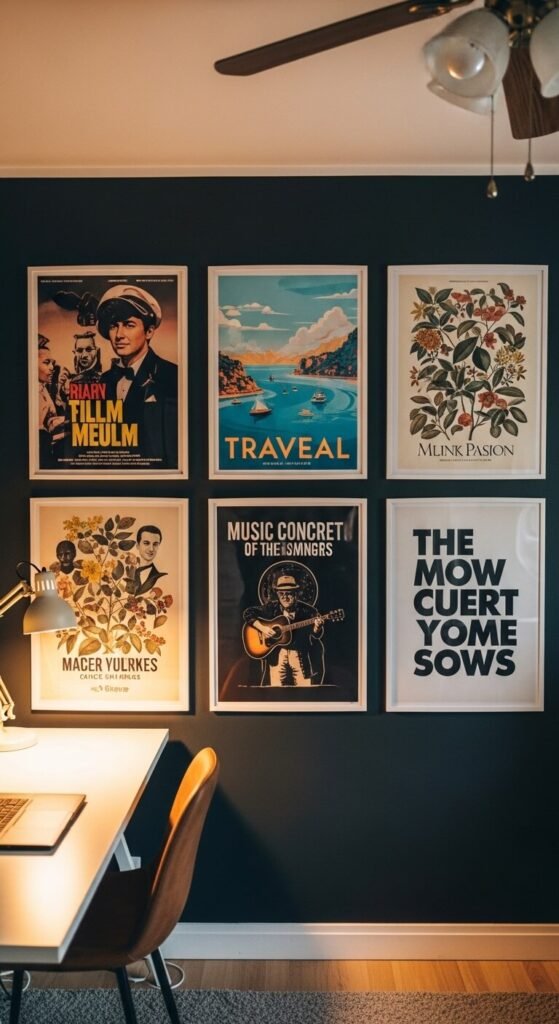
A poster collection built around genuine personal interests — film, music, sport, travel, food, science, literature — creates a gallery wall with authentic character that cannot be replicated by anyone else. Use posters from films you actually love, concerts you attended, places you have been, or subjects you know deeply. Vintage-style poster reprints for almost any topic are available online for $8 to $20 each. Frame in identical thin black or natural wood frames for visual cohesion. A dark-painted wall behind the posters makes colors pop and gives the collection a considered display quality. This is the most honest version of personal gallery wall decor possible.
19. Single Row of Frames Along a Narrow Wall
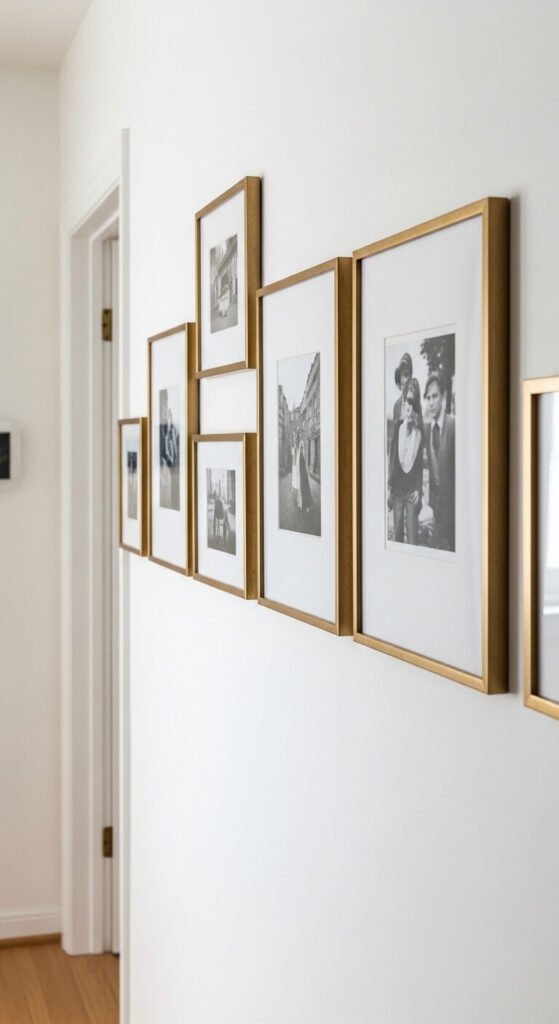
A narrow wall between two doors, a window, or architectural features suits a single precise horizontal row of frames far better than any multi-row arrangement. Align the center of every frame along a consistent horizontal line using a spirit level, varying only the width of each frame. Keep the same frame height throughout even if widths differ. This creates a ribbon of images that reads as a single continuous display rather than individual pieces. Mount the center line at standard eye level — 57 inches from floor to center of frame is the museum standard. One row of seven brass-framed photographs on a narrow wall costs $30 to $50 in total.
20. Colorful Children’s Room Art Wall
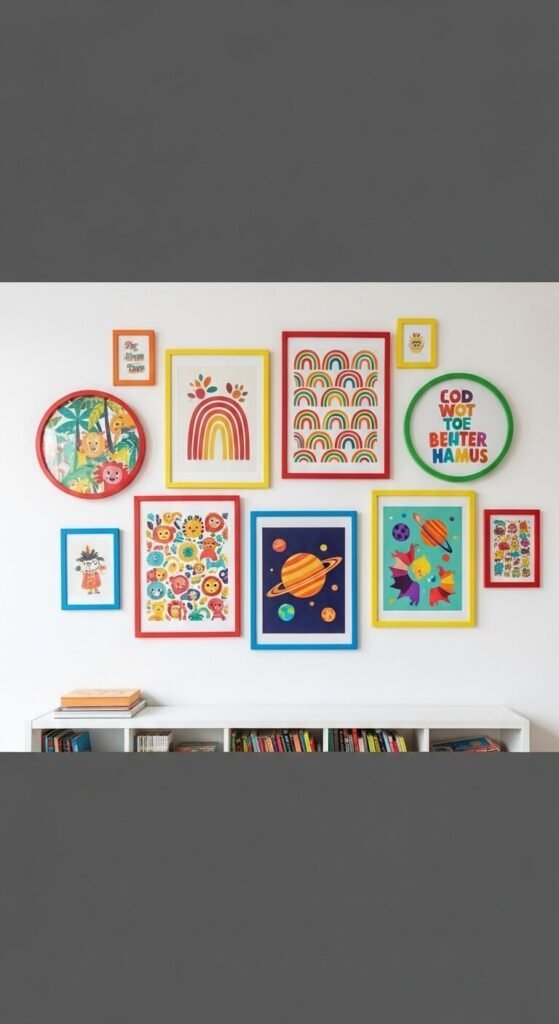
A children’s room gallery wall should feel playful, personal, and easy to update as the child grows. Paint frames in bold primary or pastel colors rather than buying matching sets — mismatched colored frames are the point here. Fill with illustrated prints, character artwork, photographs of the child at different ages, and eventually the child’s own drawings. A cheap frame set spray-painted in three colors costs $10 in materials. Illustrated prints from independent designers on Etsy cost $5 to $15 as digital downloads. As the child develops their own interests, frames and prints can be updated affordably. The wall grows with the child rather than needing to be completely replaced.
21. Dark Moody Gallery Wall with Deep Wall Color
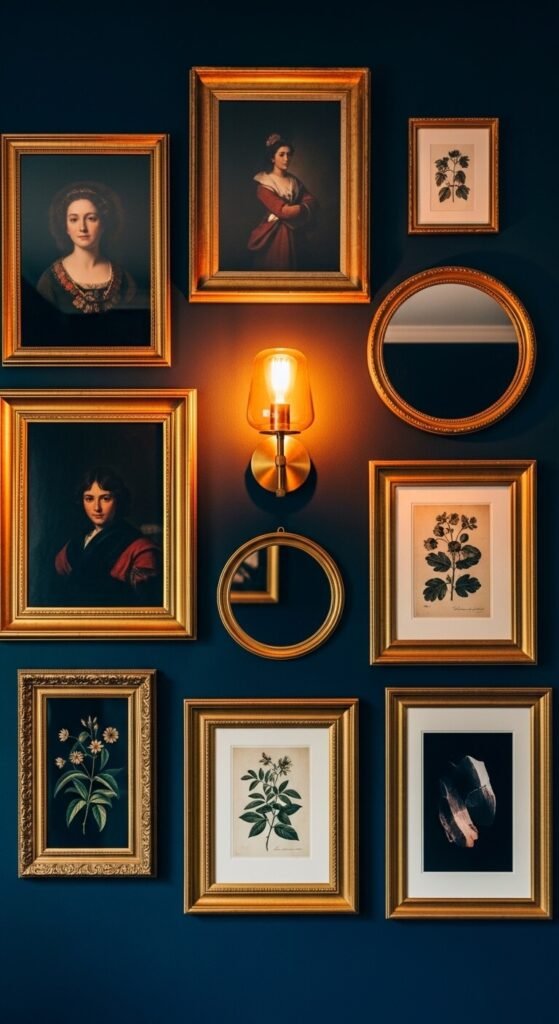
A deep-colored wall transforms every piece of artwork on it — gold frames glow, cream prints sing, and the whole arrangement feels richer and more dramatic. Choose a deep navy, forest green, charcoal, or burgundy for the gallery wall and select frames in warm metal finishes — brass, gold, and aged bronze all work beautifully against dark walls. Ornate gold frames from thrift stores and antique shops cost $3 to $20 each and look extraordinary against a dark background. A small wall sconce mounted among the frames adds a warm light source that gives the wall an atmospheric, evening-salon quality that no overhead light can replicate.
22. Personal Photography Timeline Wall
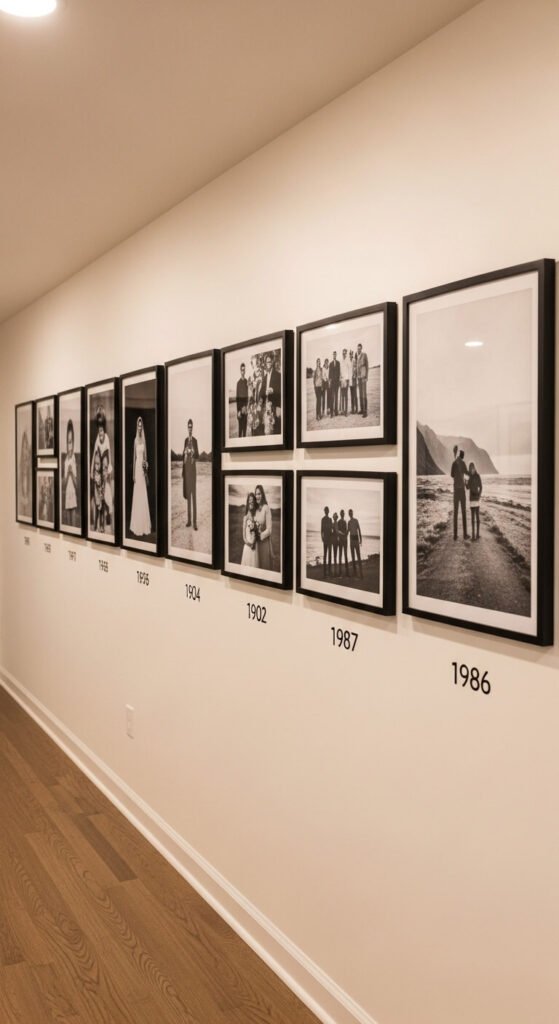
A personal photography timeline — photographs arranged roughly chronologically from left to right across a wall — creates the most genuinely narrative gallery wall possible. Print personal photographs that mark real chapters of your life at a consistent large-format size: 12×18 or 16×20 works well for this type of display. Black-and-white printing ties photographs from different decades and different cameras into a cohesive visual style. A set of 10 large-format black-and-white prints at a local print shop costs $30 to $60. Matching thin black frames cost $8 to $15 each. This is the gallery wall that visitors spend the most time standing in front of — and the one that means the most to the people who live with it.
23. Maximalist Gallery Wall with Floor-to-Ceiling Height
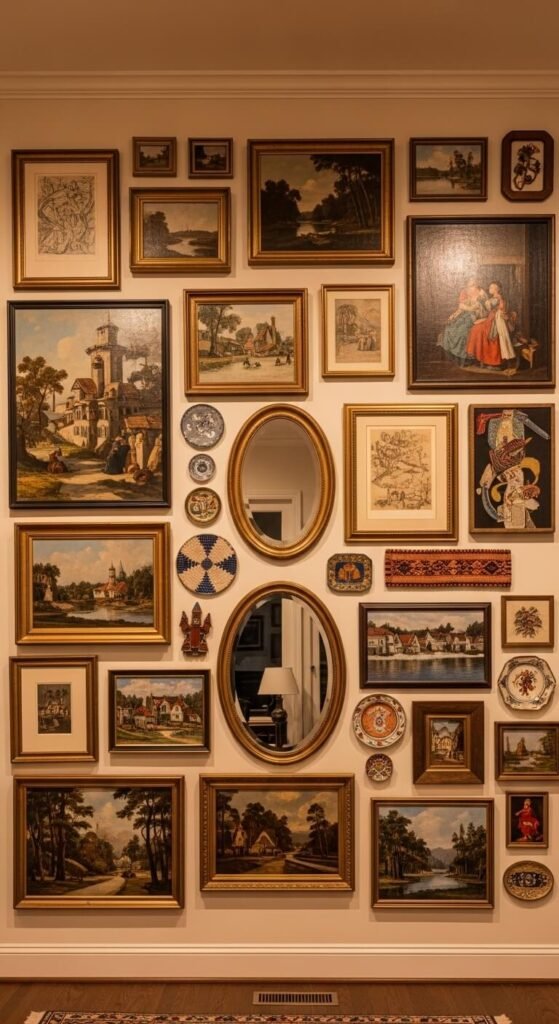
A maximalist gallery wall that fills an entire wall from floor to ceiling makes the strongest visual statement of any gallery wall format. The key to making density work is consistent spacing — maintain 1 to 2 inches between every single frame throughout the arrangement, regardless of size or content. This spacing discipline turns a crowded wall into a considered collection. Build it over time rather than all at once — a gallery wall that grows gradually looks more genuine than one purchased and hung in a single afternoon. Use thrift stores, estate sales, and art markets as your primary sources. Start with eight to ten pieces and add more over months and years.
24. Minimalist Gallery Wall with Three Oversized Pieces
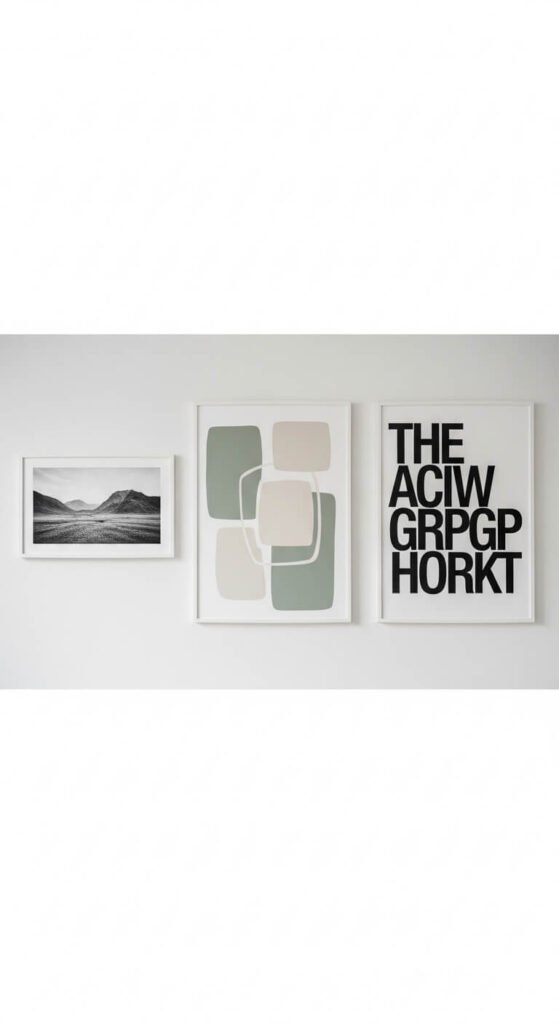
Sometimes less is the strongest choice. Three large pieces hung in a horizontal row with generous negative space between and around them creates a gallery wall that feels confident rather than cautious. Each piece should be large enough to hold attention individually — 24×30 or larger for each. The negative space between them is as intentional as the artwork itself. This layout suits modern minimalist and contemporary interiors where the wall architecture is as important as what hangs on it. Three large canvas prints from an online print service cost $30 to $60 each. Hang with precise horizontal alignment using a long spirit level. The result is clean, commanding, and immediately impressive.
25. Kids’ Handprint Art Gallery in a Playroom
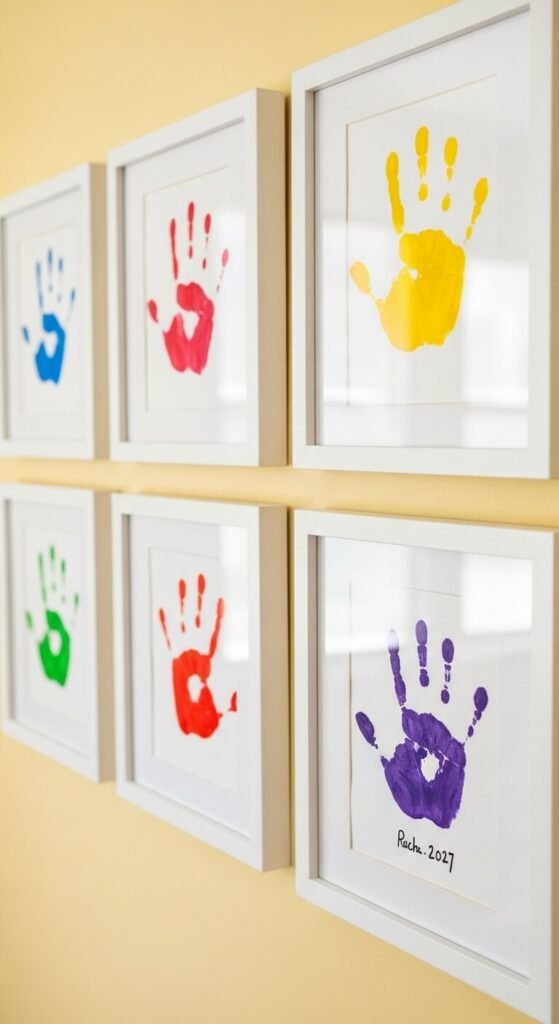
Framed children’s handprints are among the most sentimental gallery wall pieces a family can create — and they cost virtually nothing to make. Paint each child’s hand in a bold color and press firmly onto white cardstock. Write the child’s name, age, and date beneath the print in pencil before framing. Frame in identical simple white or black frames. Repeat annually to create a growing series that documents each child’s physical growth over years. A set of six framed handprints costs under $20 in total materials — paint costs $1, cardstock costs $0.10 per sheet, and basic white frames from a discount store cost $2 to $4 each. This becomes one of the most looked-at walls in any family home.
26. Abstract Color Study Series in a Dining Room
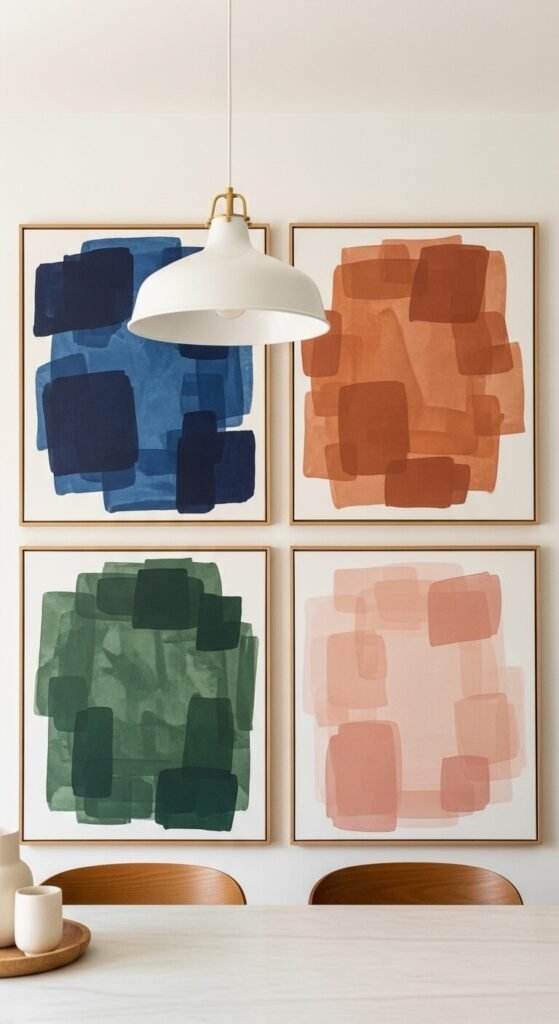
A series of large abstract color study canvases above a dining table gives the room a contemporary art gallery quality that suits the scale of a long dining wall perfectly. Paint each canvas as a large color field with loose gestural marks using one dominant color per canvas. Choose colors that relate to the dining room’s palette and to each other as a series. A set of four 24×24 canvases costs $12 to $32 in materials from a craft store. Basic acrylic paint in four colors costs $8. Thin natural wood frames from a discount framing supplier cost $15 to $25 each. A painted series of four costs under $60 total and suits any level of painting ability.
27. Eclectic Mix with One Unifying Material — Linen Mounts
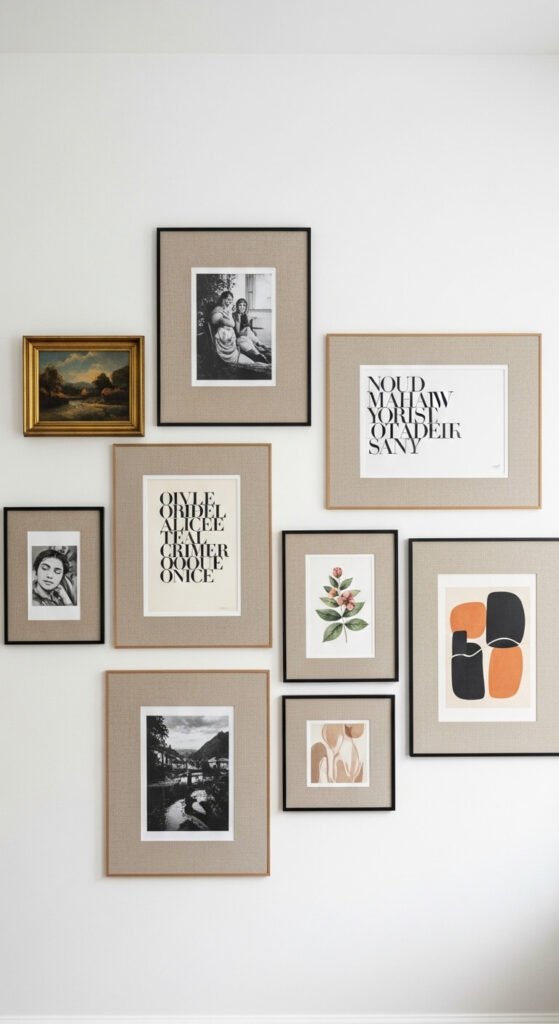
When the content of an eclectic collection is too varied for frame finish alone to unify, a consistent mount material becomes the thread that holds everything together. Linen, raw cotton, or wide white mats cut to the same border width across every piece visually equalize widely different artworks. The linen mount gives each piece a natural, textile warmth that suits eclectic and maximalist collections. Buy wide linen or cotton fabric at a fabric store and cut mat inserts to fit standard frames. This adds $2 to $5 per frame in material cost. The effect is substantial — a gallery wall that would otherwise look chaotic reads as cohesive and considered.
28. Hallway of Mirrors in Varied Frames
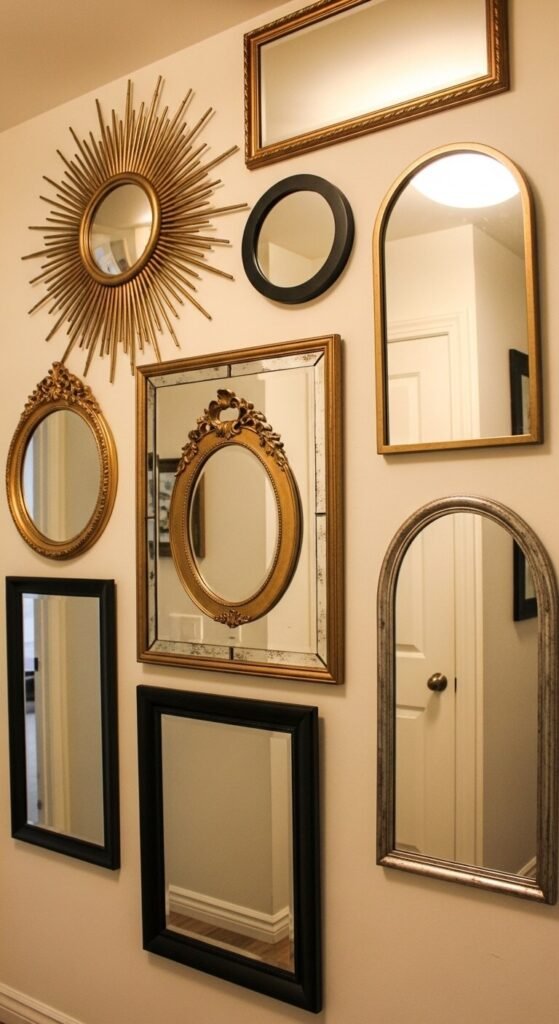
A gallery wall composed entirely of mirrors in different shapes and frame finishes creates a functional display that makes any hallway or small room feel dramatically larger. Vary shapes — round, oval, sunburst, arch, and rectangular — and mix frame finishes — gold, black, antique silver, and natural wood. The varied shapes create movement; the mirror surfaces reflect light and the room back into itself, creating real spatial depth. Decorative mirrors from thrift stores and discount homeware shops cost $5 to $30 each depending on size and finish. A hallway of eight mirrors costs $50 to $100 total and functions simultaneously as decor and practical use. No artwork or printing required.
Conclusion
A gallery wall is not built in one afternoon from a single shopping trip. The ones that genuinely tell a story — the ones that visitors stand in front of and ask about — are assembled over time from objects collected with intention. Some pieces hang for decades. Others rotate seasonally. New photographs are added as life develops; old prints are moved to different rooms as taste evolves. The layout frameworks in these 28 ideas give you the structural confidence to start. But the content — the photographs, the artwork, the collected objects, the handprints and travel maps and personal prints — that comes from paying attention to what genuinely matters to you and finding the courage to put it on the wall. Start with three pieces you already love. Build from there. The wall will tell your story because you are the only one who can choose what goes on it.